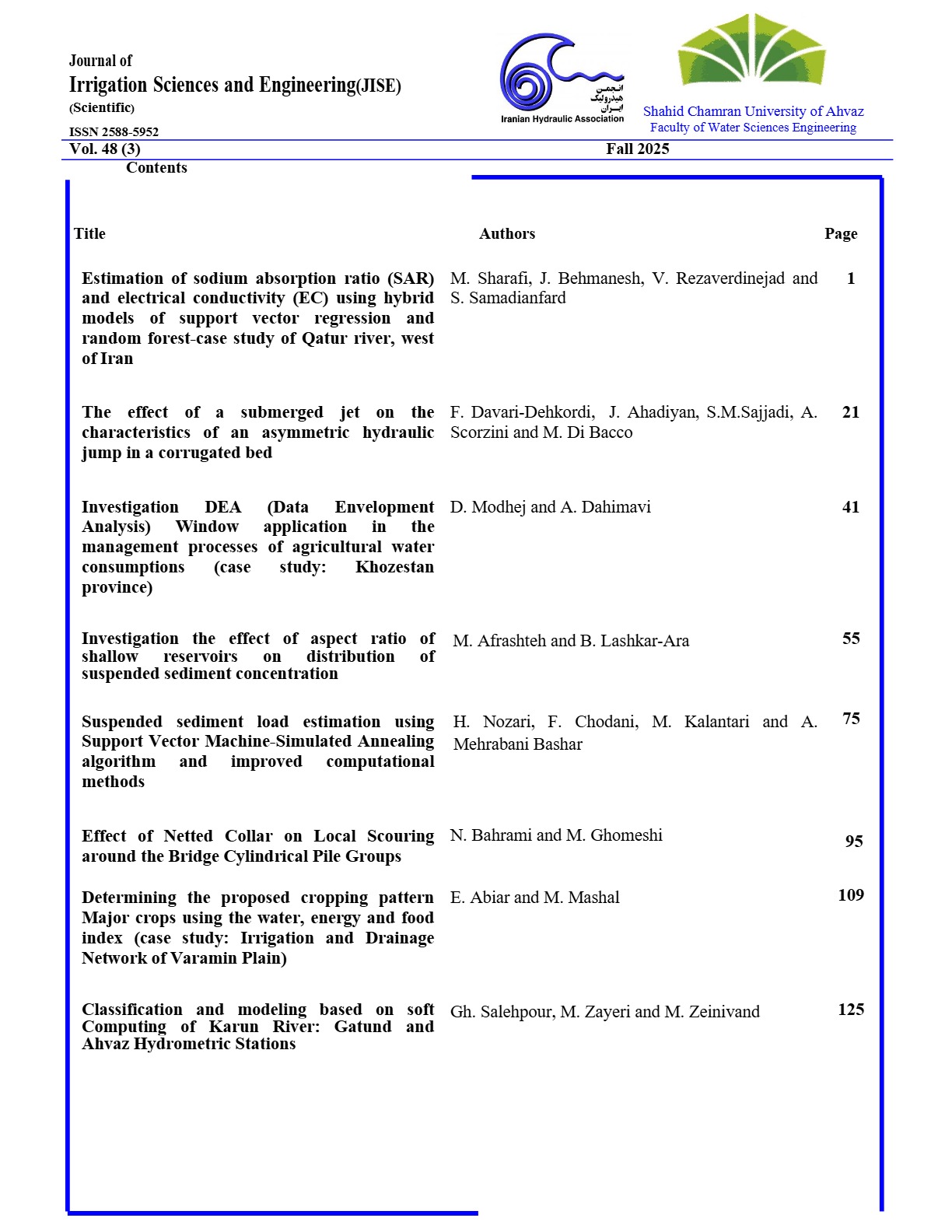
Sedimentation in settling basins is one of the significant challenges in water resource management. This phenomenon can lead to sediment accumulation in water reservoirs, reduced storage capacity, increased flood risks, and water pollution. Therefore, understanding the processes governing sedimentation in basins and optimizing the design of these structures is of great importance. In this research, the impact of aspect ratio (length to width ratio) of the reservoir on the distribution of suspended sediment concentration under free flow conditions has been investigated. Using rectangular tanks with aspect ratios of 1, 2, and 4, the sedimentation rate under various hydraulic conditions was evaluated. This parameter is recognized as one of the most critical factors affecting flow patterns and sediment deposition in settling basins. The results indicated a direct relationship between the aspect ratio of the reservoir and the distribution of suspended sediment concentrations. Specifically, reservoirs with higher aspect ratios (such as a tank with an aspect ratio of 4) retain greater amounts of suspended sediments on their surfaces. Additionally, in settling basins with high aspect ratios, the lateral spreading of dense flow creates a more favorable condition for uniform sediment distribution compared to its longitudinal spreading. Conversely, in basins with lower aspect ratios, greater longitudinal spreading occurs, increasing the likelihood of backflow formation. These findings demonstrate that considering the aspect ratio as a key parameter in the design of settling basins can significantly enhance the performance and efficiency of these structures in sediment management.
Abasi Zade Bagheban, M. and Lashkar-Ara, B., 2020. Evaluation of the Performance of the Hydraulic Suction Method in Sediment Removal of Reservoirs. Journal of Civil and Environmental Engineering, 50(98), pp.43-52. DOI: 22034/ceej.2020.11126.
Aryaei, H. and Lashkar-Ara, B., 2023. Evaluation of bottom outlet effect on the behavior of entered turbidity current into the Dez Dam reservoir. Advanced Technologies in Water Efficiency, 3(3), pp.20-36. DOI: 10.22126/ATWE.2023.9641.1061.
Asghari Pari, S.A., Kashefi Pour, S.M. and Ghomeshi, M., 2010. Experimental investigation on controlling of sedimentary density current using constructing obstacle. Journal of Irrigation Sciences and Engineering, 33(2), pp.1-15. https://doi.org/10.22055/jise.2010.13475
Brooks, R.H., 1965. Hydraulic properties of porous media. Colorado State University.
Dufresne, M., Dewals, B.J., Erpicum, S., Archambeau, P. and Pirotton, M., 2010. Experimental investigation of flow pattern and sediment deposition in rectangular shallow reservoirs. International Journal of Sediment Research, 25(3), pp.258-270. https://doi.org/10.1016/S1001-6279(10)60043-1.
Goudarzi, M., Lashkar-Ara, B. and Seyed Kaboli, H., 2021. Experimental study of the consolidation of the cohesive sediments Case study: Karkheh dam reservoir. Scientia Iranica, 28(6), pp.3072-3081. Doi: 24200/sci.2021.57114.5069.
Goodland, R., 1989. The World Bank's new policy on the environmental aspects of dam and reservoir projects. Indian Journal of Public Administration, 35(3), pp.607-633. https://doi.org/10.1177/0019556119890328.
Kantoush, S., 2007. Symmetric or asymmetric flow patterns in shallow rectangular basins with sediment transport. In Proceedings of the 32nd Congress of IAHR. https://hdl.handle.net/20.500.11970/110019.
Kantoush, S.A. and Schleiss, A.J., 2009. Channel formation during flushing of large shallow reservoirs with different geometries. Environmental Technology, 30(8), pp.855-863. https://doi.org/10.1080/09593330902990162.
Lashkar-Ara, B., Baharvand, S. and Najafi, L., 2020. The Study of the Performance of Data-Driven Models to Predict the Scour Depth Caused by the Aerated Vertical Jet. Irrigation Sciences and Engineering, 43(4), pp.79-89. doi: 10.22055/jise.2021.36599.1959.
Lashkar-Ara, B. and Kiani, F., 2025. Evaluating optimal relationships for estimating suspended sediment discharge in the Balaroud River. Irrigation Sciences and Engineering, 47(4), pp. 81-92. DOI: 10.22055/jise.2025.48205.2139.
Lee, C., Schwab, D.J. and Hawley, N., 2005. Sensitivity analysis of sediment resuspension parameters in coastal area of southern Lake Michigan. Journal of Geophysical Research: Oceans, 110(C3). https://doi.org/10.1029/2004JC002326.
Liu, R., Zhou, J.L. and Wilding, A., 2004. Microwave-assisted extraction followed by gas chromatography–mass spectrometry for the determination of endocrine disrupting chemicals in river sediments. Journal of Chromatography A, 1038(1-2), pp.19-26. https://doi.org/10.1016/j.chroma.2004.03.030
Liu, H.K., 1958. Closure to “mechanics of sediment-ripple formation”. Journal of the Hydraulics Division, 84(5), pp.5-31. https://doi.org/10.1061/JYCEAJ.0000225.
Michalec, B., 2008. Appraisal of suspended sediment concentration on reference level according to van Rijn’s method. Annals of Warsaw University of Life Sciences-SGGW. Land Reclamation, (40). https://doi.org/10.2478/v10060-008-0038-x.
Morris, G.L. & Fan, J. (1998) Reservoir Sedimentation Handbook: Design and Management of Dams, Reservoirs, and Watersheds for Sustainable Use. New York: McGraw-Hill. ISBN: 978-0-07-043302-1.
Morris, G.L. and Fan, J., 1998. Reservoir sedimentation handbook: design and management of dams, reservoirs, and watersheds for sustainable use.
Rouse, H., 1937. Modern conceptions of the mechanics of fluid turbulence. Transactions of the American Society of Civil Engineers, 102(1), pp.463-505. https://doi.org/10.1061/TACEAT.0004872.
Shadorvan, M., Lashkar-Ara, B. and Seyed Kaboli, H., 2018. Assessment of the cohesive sediments fall velocity in Karkheh Dam reservoir. Irrigation Sciences and Engineering, 41(2), pp.211-224.pp.211-224. Doi: 22055/jise.2018.22358.1601.
Afrashteh, M. & Lashkar-Ara, B. (2025). Investigation the effect of aspect ratio of shallow reservoirs on distribution of suspended sediment concentration. Irrigation Sciences and Engineering, 48(3), 55–73. https://doi.org/10.22055/jise.2025.44838.2094
MLA
Afrashteh, M., & Lashkar-Ara, B. "Investigation the effect of aspect ratio of shallow reservoirs on distribution of suspended sediment concentration", Irrigation Sciences and Engineering, 48, 3, 2025, 55–73. doi: 10.22055/jise.2025.44838.2094
HARVARD
Afrashteh, M., & Lashkar-Ara, B. (2025). 'Investigation the effect of aspect ratio of shallow reservoirs on distribution of suspended sediment concentration', Irrigation Sciences and Engineering, 48(3), pp. 55–73. doi: 10.22055/jise.2025.44838.2094
CHICAGO
Afrashteh, M. & Lashkar-Ara, B., "Investigation the effect of aspect ratio of shallow reservoirs on distribution of suspended sediment concentration." Irrigation Sciences and Engineering, 48 3 (2025): 55–73, doi: 10.22055/jise.2025.44838.2094
VANCOUVER
Afrashteh M., Lashkar-Ara B. Investigation the effect of aspect ratio of shallow reservoirs on distribution of suspended sediment concentration. JISE. 2025;48(3):55–73 (In Persian). doi: 10.22055/jise.2025.44838.2094