Irrigation Sciences and Engineering

Irrigation Sciences and Engineering

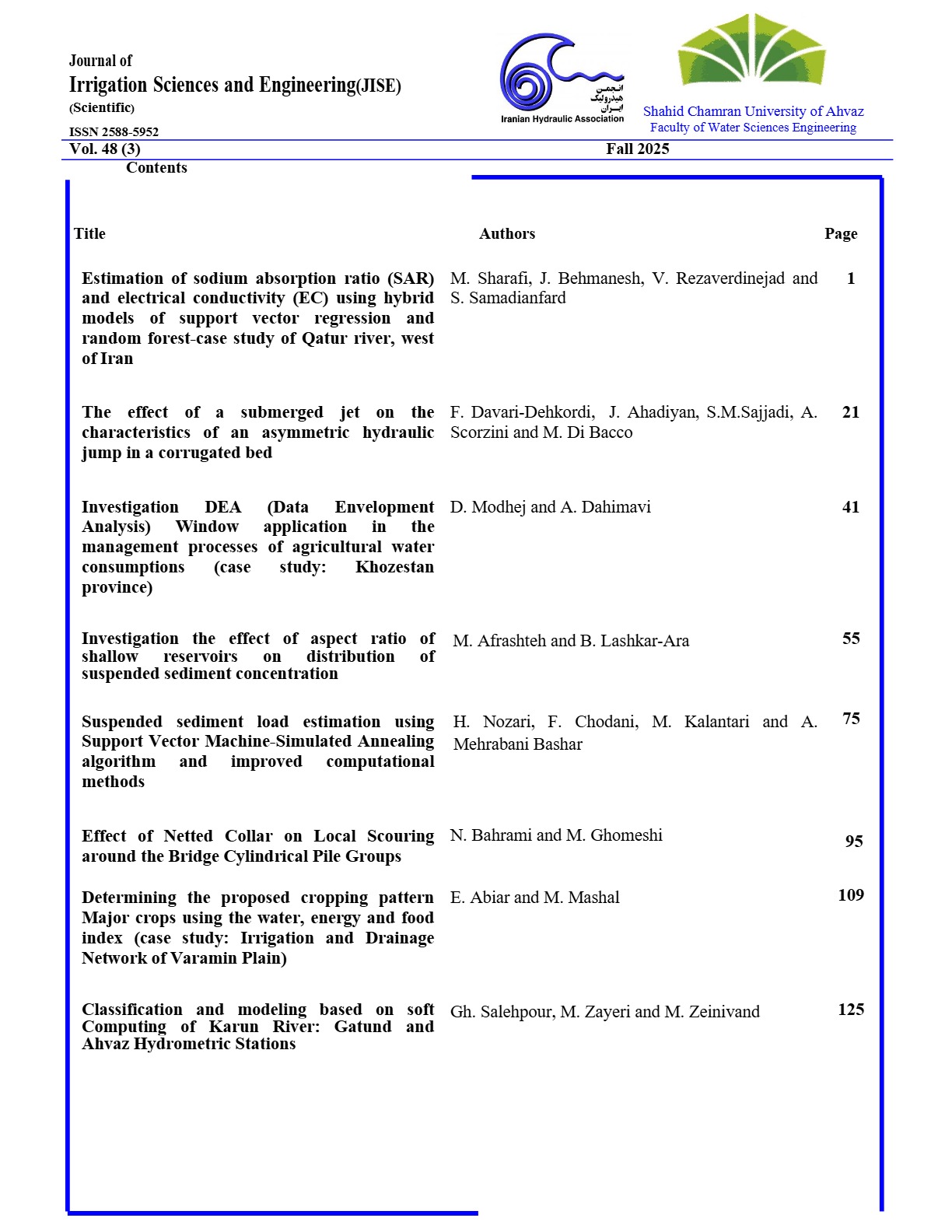
Suspended sediment load estimation using Support Vector Machine-Simulated Annealing algorithm and improved computational methods

Document Type : Research Paper

Authors
1 Associate Professor, Dapartment of Water Sciences and Engineering, Bu-Ali Sina University, Hamedan, Iran
2 M.Sc. graduated, Department of Water Sciences and Engineering, Bu-Ali Sina University, Hamedan, Iran.
3 Assistant Proffesor, Department of Statistics, Payame Noor University, Tehran, Iran.
Abstract
Studying and developing water resource systems requires an accurate prediction of river suspended sediment load. Since sediment load measurement is costly and time-consuming, the simulation methods based on the sediment load time series are usually restricted to sample numbers. This study used two different methods to forecast the monthly suspended sediment load. In the first method, the Support Vector Machine (SVM) algorithm was used to forecast sediment load based on a monthly time series of suspended sediment data. In this method, the hyperparameter coefficients of the SVM model were optimized using the Simulated Annealing (SA) algorithm. Additionally, this model was evaluated under single-input-single-output (SISO) and multiple-input-single-output (MISO) patterns. The suspended sediment load and flow data of the Yalfan River from 2007 to 2015 were the SISO’s inputs and outputs, respectively. Moreover, the MISO’s second input was a fixed number series. In the second method, the sediment rating curve and the FAO method forecast it. A %9.93-point increase in the Standard Error (SE) index was obtained by normalizing the SVM-SA’s input data. Switching the input patterns from single input-single output (SISO) to multiple input-single output (MISO) resulted in a %1.03 improvement in SE. By optimizing the coefficients of the discharge-sediment variables in the rating curve and FAO method using the General Reduced Gradient (GRG) technique, the SE index improved by %10.13 and %73.19, respectively. The results showed that the SVM-SA model based on the normalized MISO approach is the best method for suspended sediment load forecasting.
Keywords
Subjects

  • AlDahoul, N., Essam, Y., Kumar, P., Ahmed, A. N., Sherif, M., Sefelnasr, A., and Elshafie, A. 2021. Suspended sediment load prediction using long short-term memory neural network. Scientific Reports, 11(1): 1-22. DOI: 10.1038/s41598-021-87415-4.


  • Asadi, H., Dastorani, M.T., Sidle, R.C., and Shahedi, K. 2021. Improving Flow Discharge-Suspended Sediment Relations: Intelligent Algorithms versus Data Separation. Water 13(24):3650. DOI: 10.3390/w13243650.


  • Azadi, S., Nozari, H., and Godarzi, E. 2020. Predicting sediment load using stochastic model and rating curves in a hydrological station. Journal of Hydrologic Engineering, 25(8): 05020017. DOI: 10.1061/(ASCE)HE.1943-5584.0001967.


  • Azadi, S., Vafaee, M., and Nozari, H. 2022. Estimation of precipitation using the combined method of Support Vector Machine-Simulated Annealing algorithm (case study: Gorgan synoptic station). Advanced Technologies in Water Efficiency, 2(3), 14-34. (In Persian). DOI: 10.22126/ATWE.2022.8393.1028.


  • Ba, H., Guo, S., Wang, Y., Hong, X., Zhong, Y., and Liu, Z. 2018. Improving ANN model performance in runoff forecasting by adding soil moisture input and using data preprocessing techniques. Hydrology Research, 49(3): 744-760. DOI: 10.2166/nh.2017.048.


  • Bahrami, S., Ardejani, F. D., and Baafi, E. 2016. Application of artificial neural network coupled with genetic algorithm and simulated annealing to solve groundwater inflow problem to an advancing open pit mine. Journal of Hydrology, 536, 471-484. DOI: 10.1016/j.jhydrol.2016.03.002.


  • Barzegari Banadkoki, F., and Armin, M. 2016. Suspended sediment prediction using time series and sediment rating curve (Case study: Ghazaghly station in Gorganroud River). Iranian Journal of Watershed Management Science and Engineering, 9(31), 77-88. (In Persian).


  • Cortes, C., and Vapnik, V. 1995. Support-vector networks. Mach Learn 20, 273–297. DOI: 10.1007/BF00994018.


  • Deka, P. C. 2014. Support vector machine applications in the field of hydrology: A review. Applied Soft Computing, 19,372-386. DOI: 10.1016/j.asoc.2014.02.002.


  • Efthimiou, N. 2019. The role of sediment rating curve development methodology on river load modeling. Environmental Monitoring and Assessment, 191(2), 108. DOI: 10.1007/s10661-018-7167-4.


  • Fabian, V. 1997. Simulated Annealing Simulated. Computers & Mathematics with Applications, 33, 81-94. DOI: 10.1016/S0898-1221(96)00221-0.


  • Hamel, L. 2009. Knowledge Discovery with Support Vector Machines. John Wiley, Hoboken, NJ, USA. DOI: 10.1002/9780470503065.


  • Hapsari, D., Onishi, T., Imaizumi, F., Noda, K., and Senge, M. 2019. The Use of Sediment Rating Curve under its Limitations to Estimate the Suspended Load. Reviews in Agricultural Science. 7: 88-101. DOI: 10.7831/ras.7.0_88.


  • Hatami, S., Banihabib, M.E., and Soltani, J. 2020. Determination of Optimal Operation Policy of Reservior with Nonlinear Model to Reduce Reservoir Water Losses. Iranian journal of Ecohydrology, 7(1), pp. 277-290. (In Persian). DOI: 10.22059/ije.2020.295631.1266.


  • Huang, C. C., Chang, M. J., Lin, G. F., Wu, M. C., and Wang, P. H. 2021. Real-Time forecasting of suspended sediment concentrations reservoirs by the optimal integration of multiple machine learning techniques. Journal of Hydrology, 34: 100804. DOI: 10.1016/j.ejrh.2021.100804.


  • Javidan, S., Sattari, M. T., Karimzadeh, P., and Mehrabi, A. 2022. Performance Analysis of Hydrological and Data-Based Models in Estimation of Suspended Sediment Rate. Environment and Water Engineering, 8(2): 468-480. DOI: 10.22034/jewe.2021.305599.1632.


  • Kirkpatrick, S., Gelatt, C., D., and Vecchi, M., P. 1983. Optimization by simulated annealing. Science, 220, 671–680. DOI: 10.1126/science.220.4598.671.


  • Lin, J. Y., Cheng, C. T., and Chau, K. W. 2006. Using support vector machines for long-term discharge prediction. Hydrological Sciences Journal, 51(4), 599-612. DOI: 10.1623/hysj.51.4.599.


  • Mehrabani Bashar, A., Nozari, H., Marofi, S., Mohamadi, M., and Ahadiiman, A. 2023. Investigation of factors affecting rural drinking water consumption using intelligent hybrid models. Water Science and Engineering, 16(2), 175-183. DOI: 10.1016/j.wse.2022.12.002.


  • Mohammadi, B., and Heidarpour, B. 2019. Effect of climatic parameters on soil temperature estimation by hybrid refrigeration simulation algorithm. Nivar, 43((104-105), pp. 1-12. (In Persian). DOI: 10.30467/nivar.2019.83519.


  • Nouri, H., Ildoromi, A., Sepehri, M., and Artimani, M. 2019. Comparing Three Main Methods of Artificial Intelligence in Flood Estimation in Yalphan Catchment. Geography and Environmental Planning, 29(4), pp. 35-50. (In Persian). DOI: 10.22108/gep.2018.98036.0.


  • Nozari, H., and Tavakoli, F. 2018. Evaluation of the Efficiency of Linear and Nonlinear Models in Predicting Monthly Rainfall (Case Study: Hamedan Province). Journal of Watershed Management Research, 10(20): 1-12. (In Persian). DOI: 10.29252/jwmr.10.20.1.


  • Ramezanipour, E., Mosaedi, A., and Mesdaghi, M. 2017. Determination of the Best Model for Estimation of Suspended Sediment by using Statistical Error Criteria (Case Stude: Some Sub-Watersheds of Kashafroud). Journal of Watershed Management Research, 8(15): 112-124. (In Persian). DOI: 10.29252/jwmr.8.15.112.


  • Samantary, S., Sahoo, A., and Ghose, D. K. 2020. Assessment of Sediment Load Concentration Using SVM, SVM-FFA and PSR-SVM-FFA in Air Watershed, India: A Case Study. KSCE Journal of Civil Engineering, 24, 1944-1957. DOI: 10.1007/s12205-020-1889-x.


  • Sedighkia, M., and Datta, B. 2023. Linking SVM based habitat model and evolutionary optimization for managing environmental impacts of hydropower plants. River Research and Applications, 39, 897-910. DOI: 10.1002/rra.4121.


  • Shojaeezadeh, S. A., Nikoo, M. R., McNamara, J. P., AghaKouchak, A., and Sadegh, M. 2018. Stochastic modeling of suspended sediment load in alluvial rivers. Advances in Water Resources, 119: 188–196. DOI: 10.1016/j.advwatres.2018.06.006.


  • Tran, N. H., and Tran, K. 2007. Combination of fuzzy ranking and simulated annealing to improve discrete fracture inversion. Mathematical and Computer Modeling, 45(7-8), 1010-1020. DOI: 10.1016/j.mcm.2006.08.013.


  • Üneş, F., Taşar, B., Demirci, M., Zelenakova, M., Kaya, Y. Z., and Varçin, H. 2021. Daily Suspended Sediment Prediction Using Seasonal Time Series and Artificial Intelligence Techniques. Rocznik Ochrona Środowiska, 23: 117-137. DOI: 10.54740/ros.2021.008.


  • Varvani, J., and Khalighi, SH. 2007. Investigation of sediment rating curves error for estimating flood events sediment yield in Gharachay river. New Finding in Agriculture, 1(3), pp. 201-214. (In Persian).
Volume 48, Issue 3
Autumn 2025
Pages 75-93

  • Receive Date 07 October 2023
  • Revise Date 19 October 2024
  • Accept Date 21 October 2024
  • Publish Date 05 November 2025