Irrigation Sciences and Engineering

Irrigation Sciences and Engineering

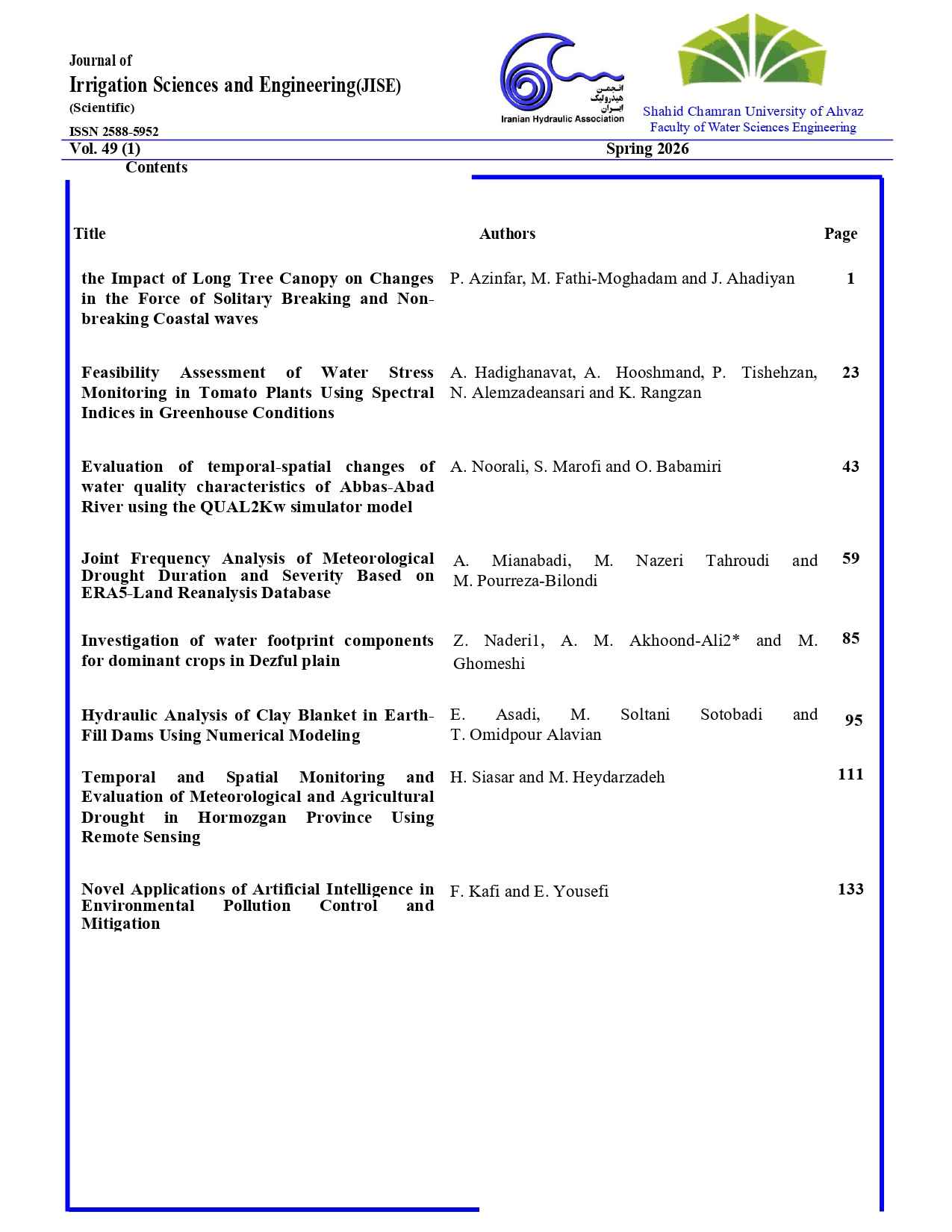
Joint Frequency Analysis of Meteorological Drought Duration and Severity Based on ERA5-Land Reanalysis Database

Document Type : Research Paper

Authors
1 Department of Ecology, Institute of Science and High Technology and Environmental Sciences, Graduate University of Advanced Technology, Kerman, Iran.
2 Department of Water Engineering, Faculty of Agriculture, Lorestan University, Khorramabad. Iran.
3 Department of Water Engineering, Faculty of Agriculture, University of Birjand, Birjand. Iran.
Abstract
Drought is a natural phenomenon that occurs when precipitation is below normal levels over period of time and is characterized by duration, severity, intensity, and frequency. Due to climate change, these characteristics have changed, necessitating updated monitoring methods. Drought characteristics were often examined separately through univariate - analyses; however, drought is an interrelated, multivariate phenomenon whose attributes are dependent on one another. Therefore, recent studies have recommended joint analysis of drought characteristics using multivariate probability functions. This study used copula functions to analyze drought duration and severity jointly. Daily precipitation data from Bandar Anzali (wet, 1755 mm average annual rainfall) and Kerman (dry, 131 mm average annual rainfall) were analyzed from 1959 to 2020 using ERA5-Land reanalysis. The Standardized Precipitation Index (SPI) was calculated for six time scales (1, 3, 6, 9, 12, and 24 months). After fitting marginal distribution functions to the variables and confirming the correlation between drought duration and severity, the best copula functions were selected for each timescale. The results showed that in the "AND" condition (D≥d AND S≥s), the probability of similar droughts was higher in Kerman than in Bandar Anzali, while in the "OR" condition (D≥d OR S≥s), the probability of droughts with either high duration or severity was greater in Bandar Anzali. Furthermore, estimating return periods by considering both duration and severity jointly provided a more accurate assessment of drought events. The resulting curves, which demonstrate the relationship between drought duration, severity, and return period, can serve as standard references for the Bandar Anzali and Kerman stations across various time scales. These curves remain applicable as long as the statistical distribution of drought duration and severity does not change. They provide a practical tool for monitoring drought across different time windows and devising more effective strategies for water resource management and mitigating drought impacts.
Keywords
Subjects

  • Abdul Rauf, U.F. and Zeephongsekul, P. 2014, “Copula based analysis of rainfall severity and duration: a case study”, Theoretical and Applied Climatology, Vol. 115 No. 1–2, pp. 153–166, doi: 10.1007/s00704-013-0877-1.


  • Ahmad, I., Ahmad, T., Rehman, S.U., Mufrah Almanjahie, I. and Alshahrani, F. 2024, “A detailed study on quantification and modeling of drought characteristics using different copula families”, Heliyon, Vol. 10 No. 3, p. e25422, doi: 10.1016/j.heliyon.2024.e25422.


  • Ali, M., Deo, R.C., Maraseni, T. and Downs, N.J. 2019, “Improving SPI-derived drought forecasts incorporating synoptic-scale climate indices in multi-phase multivariate empirical mode decomposition model hybridized with simulated annealing and kernel ridge regression algorithms”, Journal of Hydrology, Vol. 576, pp. 164–184, doi: 10.1016/j.jhydrol.2019.06.032.


  • Aschale, T.M., Cancelliere, A., Palazzolo, N., Buonacera, G. and Peres, D.J. 2024, “Analysis of the Spatiotemporal Trends of Standardized Drought Indices in Sicily Using ERA5-Land Reanalysis Data (1950–2023)”, Water, Vol. 16 No. 18, p. 2593, doi: 10.3390/w16182593.


  • Behzadi, F., Javadi, S., Yousefi, H., Hashemy Shahdany, S.M., Moridi, A., Neshat, A., Golmohammadi, G. and Maghsoudi, R., 2024. Projections of meteorological drought severity-duration variations based on CMIP6. Scientific Reports, 14(1), p.5027. doi: 10.1038/s41598-024-55340-x.


  • Chen, L. and Guo, S. 2019, “Drought Analysis Using Copulas”, Copulas and Its Application in Hydrology and Water Resources, Springer, pp. 97–116, doi: 10.1007/978-981-13-0574-0_5.


  • Dai, A. 2011, “Drought under global warming: a review”, Wiley Interdisciplinary Reviews: Climate Change, Vol. 2 No. 1, pp. 45–65, doi: 10.1002/wcc.81.


  • EskandariPour, M. and Soltaninia, S. 2022, “Analyzing the duration frequency and severity of drought using copula function in the Yazd city”, Journal of Water and Climate Change, Vol. 13 No. 1, pp. 67–82, doi: 10.2166/wcc.2021.366.


  • Frees, E.W. and Valdez, E.A. 1998, “Understanding Relationships Using Copulas”, North American Actuarial Journal, Vol. 2 No. 1, pp. 1–25, doi: 10.1080/10920277.1998.10595667.


  • Ganguli, P. and Reddy, M.J. 2012, “Risk Assessment of Droughts in Gujarat Using Bivariate Copulas”, Water Resources Management, Vol. 26 No. 11, pp. 3301–3327, doi: 10.1007/s11269-012-0073-6.


  • Gholami, S., Farajzadeh, M. and Ghavidel Rahimi, Y. 2024, “Comparative study of the performance of CHIRPS and ERA5-Land databases in detecting droughts in Iran”, Natural Geography, Vol. 16 No. 61, pp. 1-22. In Persian.
  • González, J. and Valdés, J.B. 2003, “Bivariate Drought Recurrence Analysis Using Tree Ring Reconstructions”, Journal of Hydrologic Engineering, Vol. 8 No. 5, pp. 247–258, doi: 10.1061/(ASCE)1084-0699(2003)8:5(247).


  • Grimaldi, S., Petroselli, A., Salvadori, G. and De Michele, C. 2016, “Catchment compatibility via copulas: A non-parametric study of the dependence structures of hydrological responses”, Advances in Water Resources, Vol. 90, pp. 116–133, doi: 10.1016/j.advwatres.2016.02.003.


  • Guo, C., Ning, N., Guo, H., Tian, Y., Bao, A. and De Maeyer, P. 2024, “Does ERA5-Land Effectively Capture Extreme Precipitation in the Yellow River Basin?”, Atmosphere, Vol. 15 No. 10, p. 1254, doi: 10.3390/atmos15101254.


  • Hersbach, H., Bell, B., Berrisford, P., Hirahara, S., Horányi, A., Muñoz‐Sabater, J., Nicolas, J., et al. 2020, “The ERA5 global reanalysis”, Quarterly Journal of the Royal Meteorological Society, Vol. 146 No. 730, pp. 1999–2049, doi: 10.1002/qj.3803.


  • Legg, S., 2021. IPCC, 2021: Climate change 2021-the physical science basis. Interaction, 49(4), pp.44-45.


  • Kavyani Malayeri, A., Saghafian, B. and Raziei, T. 2021, “Performance evaluation of ERA5 precipitation estimates across Iran”, Arabian Journal of Geosciences, Vol. 14 No. 23, p. 2676, doi: 10.1007/s12517-021-09079-8.


  • Kazemiazar, F., Rezaie, H. and Mirabbasi, R., 2025. Performance evaluation of monthly ERA5 and ERA5-Land Reanalysis precipitation data in the upstream of the Zayandehroud reservoir basin. Iranian Journal of Irrigation & Drainage, 19(1), pp.75-87. (In Persian).


  • Klein, B., Schumann, A.H. and Pahlow, M. (2011), “Copulas – New Risk Assessment Methodology for Dam Safety”, Flood Risk Assessment and Management, Springer Netherlands, Dordrecht, pp. 149–185, doi: 10.1007/978-90-481-9917-4_8.


  • Liu, C.-L., Zhang, Q., Singh, V.P. and Cui, Y. 2011, “Copula-based evaluations of drought variations in Guangdong, South China”, Natural Hazards, Vol. 59 No. 3, pp. 1533–1546, doi: 10.1007/s11069-011-9850-4.


  • Liu, X.-F., Wang, S.-X., Zhou, Y., Wang, F.-T., Yang, G. and Liu, W.-L. 2016, “Spatial analysis of meteorological drought return periods in China using Copulas”, Natural Hazards, Vol. 80 No. 1, pp. 367–388, doi: 10.1007/s11069-015-1972-7.


  • McKee, T.B., Doesken, N.J. and Kleist, J. 1993, “The relationship of drought frequency and duration of time scales”, Eighth Conference on Applied Climatology, American Meteorological Society, Vol. Jan17-23 No. 1993, Anaheim CA, pp. 179–186.


  • Meimandi, J.B., Bazrafshan, O., Esmaeilpour, Y., Zamani, H. and Shekari, M. 2024, “Risk assessment of meteo-groundwater drought using copula approach in the arid region”, Stochastic Environmental Research and Risk Assessment, Vol. 38 No. 4, pp. 1523–1540, doi: 10.1007/s00477-023-02641-8.


  • Mianabadi, A. 2023, “Evaluation of long-term satellite-based precipitation products for developing intensity-frequency (IF) curves of daily precipitation”, Atmospheric Research, Elsevier B.V., Vol. 286 No. February, p. 106667, doi: 10.1016/j.atmosres.2023.106667.


  • Mirabbasi, R., Fakheri-Fard, A. and Dinpashoh, Y. 2012, “Bivariate drought frequency analysis using the copula method”, Theoretical and Applied Climatology, Vol. 108 No. 1–2, pp. 191–206, doi: 10.1007/s00704-011-0524-7.


  • Mishra, A.K. and Singh, V.P. 2011, “Drought modeling – A review”, Journal of Hydrology, Vol. 403 No. 1–2, pp. 157–175, doi: 10.1016/j.jhydrol.2011.03.049.


  • Muñoz-Sabater, J., Dutra, E., Agustí-Panareda, A., Albergel, C., Arduini, G., Balsamo, G., Boussetta, S., Choulga, M., Harrigan, S., Hersbach, H. and Martens, B., 2021. ERA5-Land: A state-of-the-art global reanalysis dataset for land applications. Earth system science data, 13(9), pp.4349-4383. doi: 10.5194/essd-13-4349-2021.


  • Nadarajah, S. and Gupta, A.K. 2006. “Intensity-duration models based on bivariate gamma distributions”, Hiroshima mathematical journal, Vol. 36 No. 3, pp. 387-395, doi: 10.1029/2006WR005641.


  • Nash, J.E. and Sutcliffe, J.V. 1970, “River flow forecasting through conceptual models part I — A discussion of principles”, Journal of Hydrology, Vol. 10 No. 3, pp. 282–290, doi: 10.1016/0022-1694(70)90255-6.


  • Nazeri Tahroudi, M., Ramezani, Y., De Michele, C. and Mirabbasi, R. (2022), “Trivariate joint frequency analysis of water resources deficiency signatures using vine copulas”, Applied Water Science, Vol. 12 No. 4, p. 67, doi: 10.1007/s13201-022-01589-4.


  • Páscoa, P., Gouveia, C.M., Ribeiro, A.F.S. and Russo, A. 2024, “Compound drought and hot events assessment in Australia using copula functions”, Environmental Research Communications, Vol. 6 No. 3, p. 031002, doi: 10.1088/2515-7620/ad2bb8.


  • Pronoos Sedighi, M., Ramezani, Y., Nazeri Tahroudi, M. and Taghian, M. 2022, “Joint frequency analysis of river flow rate and suspended sediment load using conditional density of copula functions”, Acta Geophysica, Vol. 71 No. 1, pp. 489–501, doi: 10.1007/s11600-022-00894-5.


  • Ramezani, Y., Nazeri Tahroudi, M., De Michele, C. and Mirabbasi, R. (2023), “Application of copula-based and ARCH-based models in storm prediction”, Theoretical and Applied Climatology, Vol. 151 No. 3–4, pp. 1239–1255, doi: 10.1007/s00704-022-04333-9.


  • Salvadori, G. and De Michele, C. 2007, “On the Use of Copulas in Hydrology: Theory and Practice”, Journal of Hydrologic Engineering, Vol. 12 No. 4, pp. 369–380, doi: 10.1061/(ASCE)1084-0699(2007)12:4(369).


  • Shiau, J.T. 2006, “Fitting Drought Duration and Severity with Two-Dimensional Copulas”, Water Resources Management, Vol. 20 No. 5, pp. 795–815, doi: 10.1007/s11269-005-9008-9.


  • Shiau, J.T. and Modarres, R. 2009, “Copula‐based drought severity‐duration‐frequency analysis in Iran”, Meteorological Applications, Vol. 16 No. 4, pp. 481–489, doi: 10.1002/met.145.


  • Shiau, J.T. and Shen, H.W. 2001, “Recurrence Analysis of Hydrologic Droughts of Differing Severity”, Journal of Water Resources Planning and Management, Vol. 127 No. 1, pp. 30–40, doi: 10.1061/(ASCE)0733-9496(2001)127:1(30).


  • Tan, M.L., Armanuos, A.M., Ahmadianfar, I., Demir, V., Heddam, S., Al-Areeq, A.M., Abba, S.I., et al. 2023, “Evaluation of NASA POWER and ERA5-Land for estimating tropical precipitation and temperature extremes”, Journal of Hydrology, Vol. 624, p. 129940, doi: 10.1016/j.jhydrol.2023.129940.


  • Tosunoglu, F. and Can, I. 2016, “Application of copulas for regional bivariate frequency analysis of meteorological droughts in Turkey”, Natural Hazards, Vol. 82 No. 3, pp. 1457–1477, doi: 10.1007/s11069-016-2253-9.


  • Tosunoglu, F. and Kisi, O. 2016, “Joint modelling of annual maximum drought severity and corresponding duration”, Journal of Hydrology, Vol. 543, pp. 406–422, doi: 10.1016/j.jhydrol.2016.10.018.


  • Tosunoğlu, F. and Onof, C. 2017, “Joint modelling of drought characteristics derived from historical and synthetic rainfalls: Application of Generalized Linear Models and Copulas”, Journal of Hydrology: Regional Studies, Vol. 14, pp. 167–181, doi: 10.1016/j.ejrh.2017.11.001.


  • Trenberth, K.E., Fasullo, J.T. and Balmaseda, M.A. 2014, “Earth’s energy imbalance”, Journal of Climate, Vol. 27 No. 9, pp. 3129–3144.


  • Vasiliades, L., Loukas, A. and Patsonas, G. 2009, “Evaluation of a statistical downscaling procedure for the estimation of climate change impacts on droughts”, Natural Hazards and Earth System Sciences, Vol. 9 No. 3, pp. 879–894, doi: 10.5194/nhess-9-879-2009.


  • Wang, F., Wang, Z., Yang, H., Di, D., Zhao, Y. and Liang, Q. 2020, “A new copula-based standardized precipitation evapotranspiration streamflow index for drought monitoring”, Journal of Hydrology, Vol. 585, p. 124793, doi: 10.1016/j.jhydrol.2020.124793.


  • Wilhite, D.A. 2000, “Drought as a Natural Hazard: Concepts and Definitions Drought”, in Wilhite, D.A. (Ed.), Drought: A Global Assessment, New York, pp. 3–18.


  • Xu, C., Wang, W., Hu, Y. and Liu, Y. 2024, “Evaluation of ERA5, ERA5-Land, GLDAS-2.1, and GLEAM potential evapotranspiration data over mainland China”, Journal of Hydrology: Regional Studies, Vol. 51, p. 101651, doi: 10.1016/j.ejrh.2023.101651.


  • Yevjevich, V. 1967, “An objective approach to defnitions and investigations of continental hydrologic droughts”, Hydrology Papers, Vol. 23, pp. 1–18.


  • Yilmaz, M. 2023, “Accuracy assessment of temperature trends from ERA5 and ERA5-Land”, Science of The Total Environment, Vol. 856, p. 159182, doi: 10.1016/j.scitotenv.2022.159182.


  • Yue, S. and Rasmussen, P. 2002, “Bivariate frequency analysis: discussion of some useful concepts in hydrological application”, Hydrological Processes, Vol. 16 No. 14, pp. 2881–2898, doi: 10.1002/hyp.1185.


  • Zhang, Q., Xiao, M., Singh, V.P. and Chen, X. (2013), “Copula-based risk evaluation of droughts across the Pearl River basin, China”, Theoretical and Applied Climatology, Vol. 111 No. 1–2, pp. 119–131, doi: 10.1007/s00704-012-0656-4.
Volume 49, Issue 1
Spring 2026
Pages 59-84

  • Receive Date 26 December 2024
  • Revise Date 21 April 2025
  • Accept Date 12 May 2025
  • Publish Date 05 May 2026