Irrigation Sciences and Engineering

Irrigation Sciences and Engineering

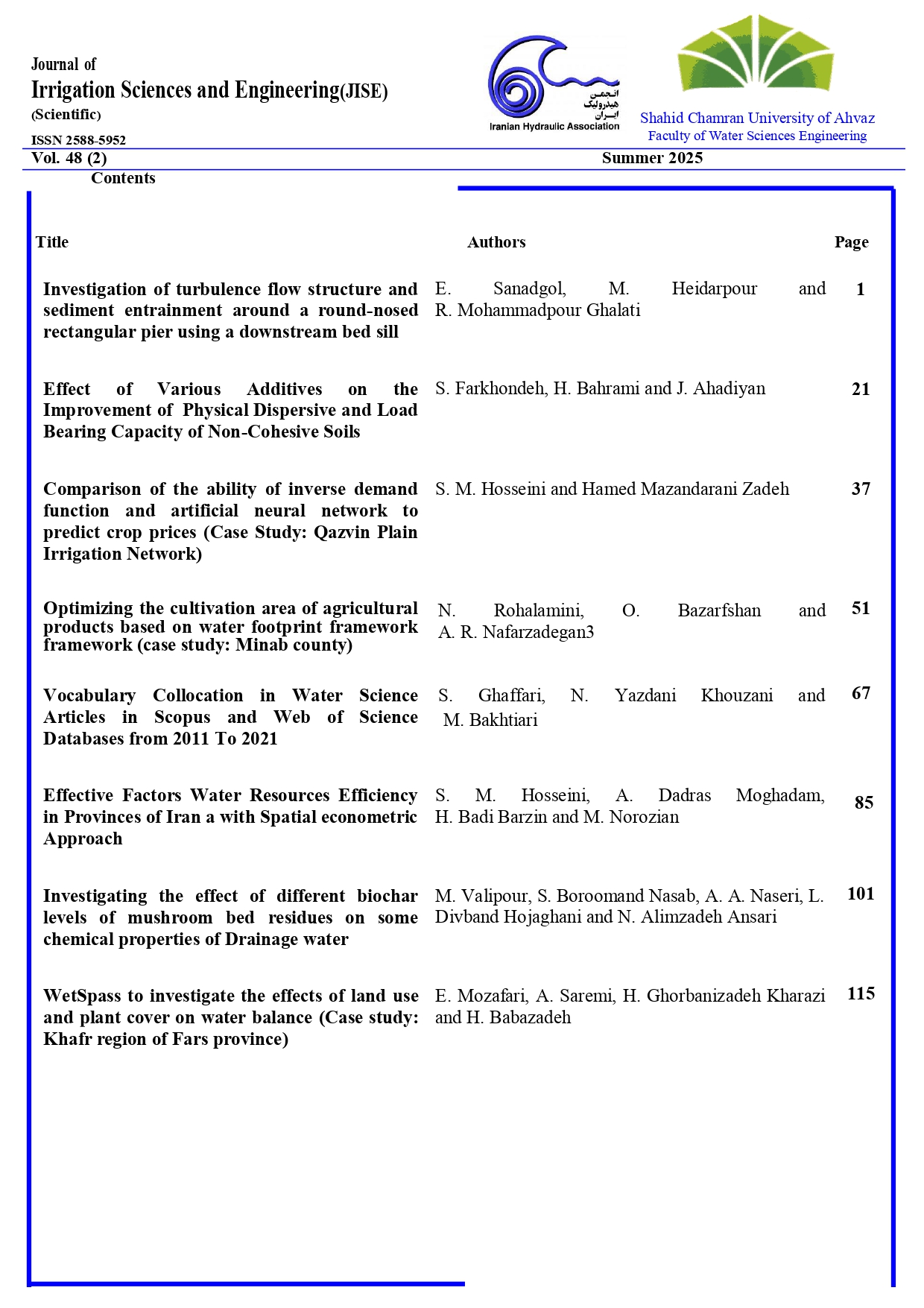
Effect of Various Additives on the Improvement of Physical Dispersive and Load Bearing Capacity of Non-Cohesive Soils

Document Type : Research Paper

Authors
1 Master of Engineering in Coastal and Marine Industries.
2 Assistant Professor of Marine Structures, Faculty of Marine Engineering, Marine Science and Technology University of Khorramshahr
3 Professor, Hydraulic Structures Department, Faculty of Water and Environmental Engineering, Shahid Chamran University of Ahvaz, Ahvaz, Iran.
Abstract
Soil mechanical properties change with increasing humidity and saturation. In some soils, due to increased humidity, certain phenomena sometimes lead to damages in construction projects. These soils are called water-sensitive soils (Askari & Fakher, 1995). One type of these soils is dispersive soil. Dispersive means the separation of fine particles from each other, which leads to soil erosion. Divergence is a phenomenon in which soil particles float due to contact with water and exit the ambiance because of the force generated by water flow. It can be physical-chemical (clay) or physical (fine sand and non-cohesive silt). The erosion of clay particles mainly triggers to overcome repulsive forces between particles. In contrast, the transfer of particles in fine-grained sand is due to their lack of adhesion and small size. This action causes internal erosion in the soil (Rahimi et al., 2004). As a result, a divergence is a progressive event that begins with water flow from one point and gradually expands. Recent experiences have shown that insufficient attention to this phenomenon has caused adverse effects. The scouring of many earth dams, the walls of canals, and even the possible failure of structures, especially in the vicinity of areas bordering water, are examples of such problems (Sarshar, 1992). So far, extensive research has been carried out on the chemical divergence of soils, and therefore, numerous chemical and physical methods have been proposed for their determination. Although most scientists who have studied divergent soils have pointed to the physical divergence of soil, a comprehensive study on how and why divergence of these soils occurs and a basis for their identification and classification have yet to be addressed appropriately.
Keywords
Subjects

  • Ahadian, J., Jalal, R. E., and Mahmoud, S. B. 2008. Determination of soil compression index, Cc, in Ahvaz region. Journal of Faculty Engineering, 35 (3-51): 75–80. (In Persian).


  • Ahadian, J., Salemnia, A., Karimi, M. 2012. Effect of compaction test component on development of stress-strain in the clay soil in comparison with sandy-clay soil, Journal of Water and Soil Resources Conservation, 1(2), 29. DOR: 1001.1.22517480.1390.1.2.3.3 .(In Persian).


  • Ahadian, J., Behroozi, F. 2014. 'Estimate the Compression index, Swelling and Preloading Coefficient in the Presence of Special Restorative of Clay-Gypsum soils, Advanced Applied Geology, 4(1), pp. 10-17. (In Persian).


  • Ahadiyan, J. and Behroozi. F. 2016. Application of ANFIS Adaptive System to Estimate the Potential Consolidation of Clay Soils, Journal of Modeling in Engineering, 14(45), pp. 17-31. doi: 10.22075/jme.2017.1760. (In Persian).


  • Ahadiyan, J., Poursaki, R., Seraj, M. 2017. Analytical Investigation of Effect of Vertical Drains to Consolidation Settlement Process in Isotropic Soils, Irrigation Sciences and Engineering, 40(1-1), pp. 61-72. doi: 10.22055/jise.2017.12957 (In Persian).


  • Ahadiyan, J., Bahmanpouri, F., Adeli, A. Galtieri, C., Khoshkonesh, A. 2022. Riprap Effect on Hydraulic Fracturing Process of Cohesive and Non-cohesive Protective Levees. Water Resources Managementjournal, 36, 625–639 (2022). https://doi.org/10.1007/s11269-021-03044-6.


  • Askari,F. and Fakher,A.,1993. Inflation and Dispersive of Soils in Geotechnical Engineering.Isfahan University Technology Branch Press and Publishing (In Persian).


  • ASTM, Standard test methods for determining dispersive characteristics of clayey soils by the Crumb test, ASTM Designation: D6572-00, Last updated: May 27, 2021.


  • ASTM, Standard Test Method for Identification and Classification of Dispersive Clay by the Pinhole Test, ASTM Designation: D4647, Last Updated: Feb 26, 2020.


  • Baibordy, M., 1994. Soil physics. Tehran University Press and Publishing (In Persian).
  • Bakhtiar, M., Ahadiyan, J. 2018. Estimation of Lateral Forces on Retaining Walls Adjacent to Layered Embankments in Saturated and non-Saturated Conditions, Amirkabir Journal of Civil Engineering, 50(1), pp. 19-30. doi: 10.22060/ceej.2017.11859.5090. (In Persian).


  • Bakhtiari, M., Kamal Pour, A.E., Ahadiyan, J. 2018. Numerical Modeling of soil dynamic compaction using Finite Difference method, Advanced Applied Geology, 8(1), pp. 60-68. doi: 10.22055/aag.2018.23603.1769. (In Persian).


  • Bakhtiari, M., Kamal pour asl, E., Ahadiyan, J. 2020. Investigation of the effect of Hammer radius parameters and number of impact on soil improvement by dynamic density method In line with the construction of offshore structures, Journal of Marine Science and Technology, 18(4), pp. 75-90. doi: 10.22113/jmst.2018.100314.2060. (In Persian).


  • Bayer, H., Abden-Nabi, H., 1993, Analysis of dispersive phenomenon of some Jordanian soils, S. thesis.


  • Behroozi, F., Ahadian, J. 2014. 'Effect of Adding Lime to the Consolidation Properties of Clay–Gypsum Soils', Irrigation Sciences and Engineering, 37(2), pp. 61-70. Doi: 1001.1.25885952.1393.37.2.6.6.


  • Bolouri-Bazaz, J., Saghafy, H. R., 2003, Properties and behavior of dispersive clayey soil treated by PVA, International Conference on Geotechnical Engineering, Beirut.


  • Daryaei, M.; Kashefipour, S.M.; Ahadian, J.; Ghobadian, R. 2010. Modeling the compression index of fine soils using an artificial neural network and comparison with other empirical equations. Journal of Water and Soil. 2010, 5, 312–333. https://doi.org/10.22067/jsw.v0i0.3885.


  • Farzi, M., and Ahadian, J. 2014. The Effect of Mixing Method on the Permeability Changes of Cement-Bentonite. European Online Journal of Natural and Social Sciences, 3(3), pp. 8-16.


  • Haghdoost, M., Lakzian, E., Norouzi, R., Abraham, J., Sajjadi, S. and Ahadiyan, J., 2023. Numerical simulation using the finite element method to investigate the effect of internal cutoff walls on seepage and hydraulic gradients in homogeneous earth dams. Modeling Earth Systems and Environment, 9(4), pp.3851-3864.https://doi.org/10.1007/s40808-023-01755-w.


  • Haghdoost, M., Sajjadi, S. M., Ahadiyan, J., Norouzi, R., & Abraham, J. 2024. The effect of sheet piles’ inclination angle, number, and distance on seepage through an earth-fill dam. Ain Shams Engineering Journal, 15(12), 103056. https://doi.org/10.1016/j.asej.2024.103056.


  • Ingles O. G. & G. D. Aitchison. 1967. Soil- Water Disequilibrium as a Cause of Subsidence in Natural Soils and Earth Embankments. International Symposium on Land Subsidence, Tokyo, AIHS Publication NO.89, VOL.2.


  • Karimi, M., Salemnia, A. and Ahadiyan, J., 2010. Evaluation of strength parameters of stress-strain development in clay soil and clay-sand soil. International Journal of Civil & Structural Engineering, 1(3), pp.644-660.


  • Kiyani A, Zeinivand M, Ahadiyan J, Falorca I. 2024. Experimental Investigation of Embankment Wedge Failure’s Stability under the Effect of the Number and Spacing of Geotextile Layers in the Reinforced Retaining Wall. Journal of water and soil science, 2024; 28 (2) :177-194. Doi: 47176/jwss.28.2.51162.

  • Mazarei, H., Ahadiyan, J. 2018. Effect of unsaturated soil texture and compaction in experimental Analysis and River retaining wall failure wedge elasto-plasticity, Irrigation Sciences and Engineering, 40(4), pp. 197-212. doi: 10.22055/jise.2018.13431. (In Persian).


  • Memarian, S., Ahadiyan, J., & Reza Karimi, H. 2023. Assessment of vertical pile reinforcement effect on behavior of foundations placed on Slopes: An experimental and numerical study. Ain Shams Engineering Journal, 14(12), 102233. https://doi.org/10.1016/j.asej.2023.102233.
  • Poursaki, R., Ahadian, J., Seraj, M. 2015. 'A 3-D Mathematical Modeling in Solving Analytical Consolidation Equation in a Homogeneous Saturated Soil', Journal of Advanced Mathematical Modeling, 5(1), pp. 59-74. doi: 10.22055/jamm.2015.11487. (In Persian).


  • H, Davarzani.H, and Abbasi.N, 2004. Physical Dispersivity Phenomenon and its Evaluation Criteria in Cohesionless Soils. Iranian Journal of Agricultural Science. Vol. 35, No. 3. (In Persian).


  • Rahimi H. and Fakour, K., 1995, Comparison of portland cement and asphalt emulsion for stabilization of Dispersive soils, Iranian Journal of Agricultural Science.(26)4. (In Persian).


  • Rahimi, H., 1989, "Problems of Water Structures in Salt and Gypsiferous Soils", The First Geotechnical Assembly in Dam Construction and Water Resources, (In Persian).


  • Sadeghi E., Ahadiyan, J. 2018. Hydraulically Failure Mechanism of non-Cohesive Homogenous Protective Embankments by Overtopping, Irrigation Sciences and Engineering, 41(1), pp. 115-131. doi: 10.22055/jise.2018.13575. (In Persian).


  • Shah, S. S. and Omar, H., 1998, A case study of stabilization of dispersive soil using lime, International symposium of Problematic Soils, Balkema.


  • Sarshar, P., 1992. Investigation of the Divergence of Clay Soils in Hydraulic Structures. Iran University of Science & Technology (In Persian).


  • Sherard, J.L., Dunnigan, L.P. and Decker, R.S., 1976. Identification and nature of dispersive soils. Journal of the Geotechnical Engineering Division, 102(4), pp.287-301. Doi: 1061/AJGEB6.0000256.


  • Sherard, J.L., 1972. Hydraulic fracturing in low dams of dispersive clay. In  of Specialty Conference on Earth and Earth-Supported Structures, 1972(pp. 653-689). ASCE.


  • Toktaş, F., 2001. Behavior and stabilization of dispersive soils with C-type fly ash (Master's thesis, Middle East Technical University).
Volume 48, Issue 2
Summer 2025
Pages 21-33

  • Receive Date 17 July 2019
  • Revise Date 14 October 2021
  • Accept Date 16 October 2021
  • Publish Date 23 August 2025