علوم و مهندسی آبیاری

علوم و مهندسی آبیاری

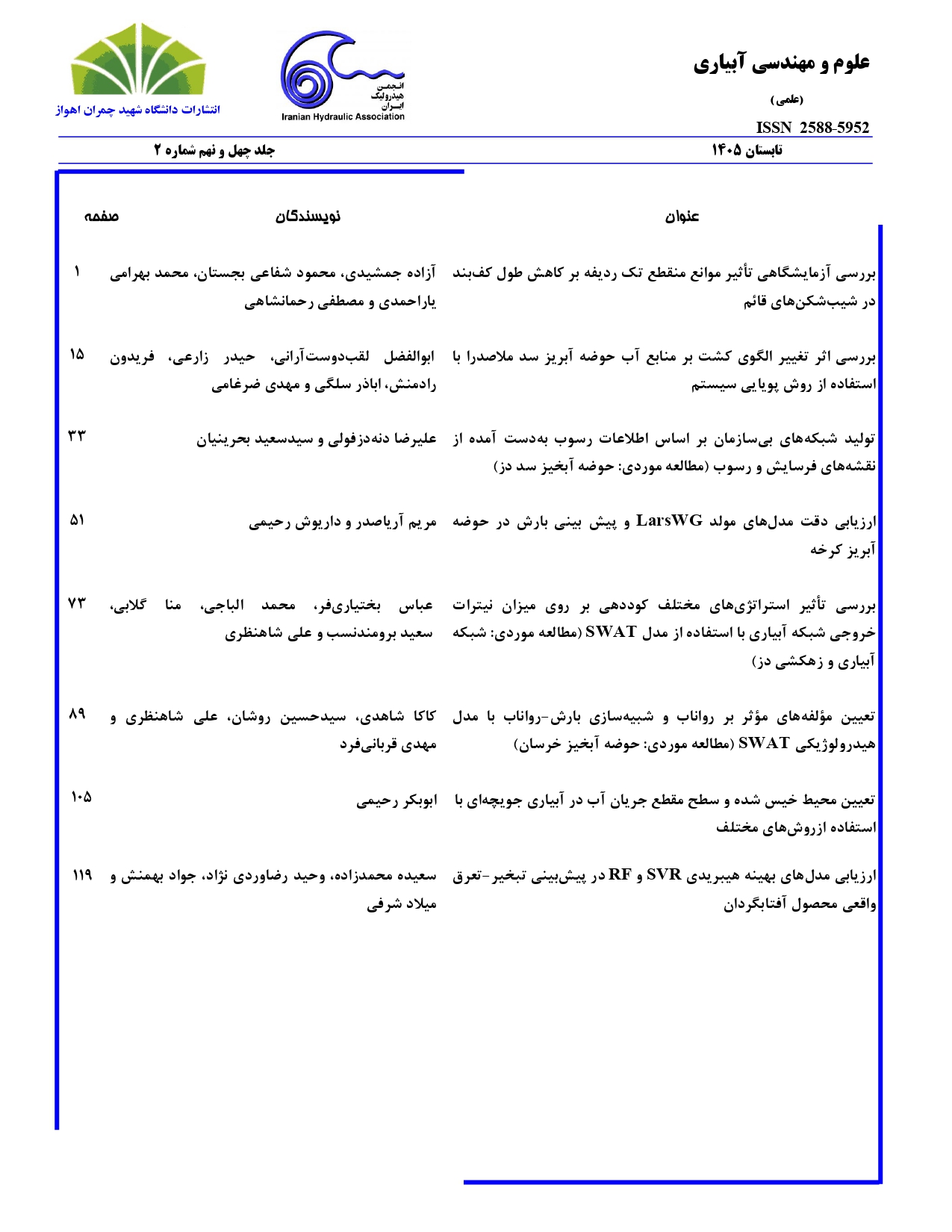
بررسی آزمایشگاهی تأثیر موانع منقطع تک ردیفه بر کاهش طول کف‌بند در شیب‌شکن‌های قائم

نوع مقاله : مقاله پژوهشی

نویسندگان
1 دانش آموخته کارشناسی ارشد، دانشکده مهندسی آب و محیط زیست دانشگاه شهید چمران اهواز، اهواز، ایران.
2 دانشکده مهندسی آب و محیط زیست دانشگاه شهید چمران اهواز، اهواز، ایران
3 دانشیار، دانشکده مهندسی آب و محیط زیست دانشگاه شهید چمران اهواز، اهواز، ایران.
4 محقق، دانشگاه پلی تکنیک هنگ کنگ، هنگ کنگ، چین.
چکیده
از جمله سازه­های هیدرولیکی مورد استفاده در آبخیزداری به­‌منظور مدیریت رسوب در آبراهه­های کوهستانی شیب شکن‌های قائم می­باشد. به­منظور جلوگیری از آبشستگی بستر در پایین دست شیب شکن قائم از کف­بند استفاده می­شود که روی آن پرش هیدرولیکی شکل می­گیرد. یکی از پارامترهای مهم طراحی کاهش طول پرش هیدرولیکی و در نتیجه کاهش طول کف­بند برای اقتصادی شدن پروژه می­باشد که هدف اصلی این تحقیق محسوب می­شود. آزمایش­ها در فلوم مستطیلی به عرض 30 سانتی‌متر و طول 12 متر انجام شده است. آزمایش­های این تحقیق به دو دسته با مانع و بدون مانع تقسیم می­شود. در آزمایش با مانع از یک ردیف مانع منقطع به ارتفاع پنج سانتی­متر که در فاصله 40 سانتی­متری از شیب شکن نصب شده بود، استفاده شد. علاوه بر این در آزمایش با مانع از آستانه در انتهای کف­بند استفاده شد. ارتفاع آستانه انتهایی دو، سه و چهار سانتی­متر در نظر گرفته شد. آزمایش­ها تحت هفت شرایط مختلف جریان (عداد فرود  در محدوده 34/6 تا 5/12در ابتدای پرش) انجام شدند. نتایج نشان داد که استفاده از مانع منقطع به­همراه آستانه انتهایی باعث کاهش طول پرش هیدرولیکی شده است. تغییر ارتفاع آستانه انتهایی تأثیری زیادی بر کاهش طول پرش هیدرولیکی نداشت بگونه­ای که حداکثر تاثیر آن حدود 7/5 درصد می­باشد. نتایج نشان داد که استفاده از مانع منقطع به­همراه آستانه انتهایی به ارتفاع­های 05/0، 08/0 و 11/0 برابر ارتفاع شیب شکن باعث شد طول پرش هیدرولیکی به­ترتیب 52، 53 و 7/57 درصد کاهش یابد.
کلیدواژه‌ها
موضوعات

عنوان مقاله English

Experimental investigation of the effect of single-row dentate baffles on the length of vertical drop structure

نویسندگان English

Azadeh Jamshidi 1
Mahmood Shafai Bejestan 2
Mohammad Bahrami Yarahmadi 3
Mostafa Rahmanshahi 4
1 MSc student, Faculty of Water and Environmental Engineering, Shahid Chamran University of Ahvaz, Ahvaz, Iran.
2 Professor, Faculty of Water and Environmental Engineering, Shahid Chamran University of Ahvaz, Ahvaz, Iran.
3 Associate professor, Faculty of Water and Environmental Engineering, Shahid Chamran University of Ahvaz, Ahvaz, Iran.
4 Research assistant, University of Hong Kong, Hong Kong.
چکیده English

Among the hydraulic structures used in watershed management for sediment management in mountain streams are vertical weirs. In order to prevent bed erosion downstream of the structures a horizontal concrete slab is used which a hydraulic jump is formed. One of the important design parameters is to reduce the length of the hydraulic jump and, as a result, reduce the length of the slab for the economic efficiency of the project, which is the main goal of this research. The experiments were conducted in a rectangular flume 30 cm wide and 12 m long. The experiments in this research are divided into two groups with and without barriers. In the experiment with barriers, a row of dentated barriers with a height of five centimeters installed at a distance of 40 centimeters from the weir toe. In addition, in the experiment with barriers, a sill was used at the end of the weir. The height of the end sill was considered to be two, three, and four centimeters. The experiments were conducted under seven different flow conditions (Froude number in the range of 6.34 to 12.5 at the beginning of the jump). The results showed that the use of a discontinuous barrier with the end sill reduced the length of the hydraulic jump. Changing the height of the final sill did not have a significant effect on reducing the length of the hydraulic jump, with a maximum effect of about 5.7%. The results showed that the use of a discontinuous barrier at heights of 0.05, 0.08, and 0.11 times the height of the structure reduced the length of the hydraulic jump by 52, 53, and 57.7 percent, respectively.

کلیدواژه‌ها English

bed erosion
grade control structure
vertical drop structures
dam reservior
  • Belanger, J.B., 1828. Essai sur la solution numerique de quelques problemes relatifs au mouvement permanent des eaux courantes; par m. J.-B. Belanger.. Chez Carilian-Goeury, libraire, des corps royaux des ponts et chaussees et des mines.


  • Blaisdell, F.W., 1959. The SAF stilling basin: A structure to dissipate the destructive energy in high-velocity flow from spillways(No. 156). Agricultural Research Service.


  • Chiu, C.L., Fan, C.M. and Tsung, S.C., 2017. Numerical modeling for periodic oscillation of free overfall in a vertical drop pool. Journal of Hydraulic Engineering, 143(1), p.04016077. DOI:10.1061/(ASCE)HY. 1943-7900.0001236.


  • Daneshfaraz, R., Hasanniya, V., Mirzaei, R. and Bazyar, A., 2020. Experimental investigation of the effect of positive slope of the horizontal screen on hydraulic characteristics of vertical drop. Iranian Journal of Soil and Water Research, 50(10), pp.2499-2509. DOI:10.22059/ijswr.2019.283685.668238. (In Persian)


  • Daneshfaraz, R., Majedi Asl, M. and Jafari, M., 2021. Experimental study of the effect of the location of the horizontal screen from the edge of the vertical drop on the pool depth and the amount of downstream energy loss. Irrigation and Drainage Structures Engineering Research, 22(84), pp.55-68.org/10.22092/idser.2021.355547.1482. (In Persian)


  • Doustkam, M., Rahmanshahi, M., Fathi-Moghadam, M., Keramat, A. and Duan, H.F., 2024. Experimental study on the hydraulic performance of porous broad-crested weirs with sloping crests. Water Resources Management, 38(12), pp.4783-4802., DOI: 10.1007/s11269-024-03887-9.


  • Ghaderi, A., Dasineh, M. and Abbasi, S., 2019. Impact of vertically constricted entrance on hydraulic characteristics of vertical drop (numerical investigation). Journal of Hydraulics, 13(4), pp.121-131.org/10.30482/jhyd.2019.82713. (In Persian)


  • Gill, M. A. 1979. Hydraulics of rectangular vertical drop structures. Journal of Hydraulic Research, 17(4): 289-302. DOI:10.1080/00221687909499573


  • Hasannia, V., Daneshfaraz, R. and Sadeghfam, S., 2020. Experimental investigating on hydraulic parameters of vertical drop equipped with combined screens. Amirkabir Journal of Civil Engineering, 52(10), pp.2487-2500. DOI: 10.22060/ceej.2019.16431.6223. (In Persian)


  • Hong, Y.M., Huang, H.S. and Wan, S., 2010. Drop characteristics of free-falling nappe for aerated straight-drop spillway. Journal of Hydraulic Research, 48(1), pp.125-129. https://doi.org/10.1080/00221680903568683.


  • Izadjoo, F., & Shafai-Bejestan, M. 2007. Corrugated bed hydraulic jump stilling basin. Journal of Applied Sciences, 7(8): 1164-1169.


  • Liu, S.I., Chen, J.Y., Hong, Y.M., Huang, H.S. and Raikar, R.V., 2014. Impact characteristics of free over-fall in pool zone with upstream bed slope. Journal of Marine Science and Technology, 22(4), p.9. http://dx.doi.org/10.6119/JMST-013-0604-1.


  • Mirzaee, R., Hosseini, K. and Mousavi, F., 2021. Numerical investigation on energy loss in vertical drop with horizontal serrated edge. Journal of Hydraulics, 16(1), pp.23-36. DOI: 10.30482/jhyd.2021.256774.1486. (In Persian).


  • Moore, W.L., 1943. Energy loss at the base of a free overfall. Transactions of the American Society of Civil Engineers, 108(1), pp.1343-1360.


  • Pasbani Khiavi, M. and Hasanniya Giglou, V., 2022. Numerical Study of the Effect of Height of Vertical Screens on Vertical Drop Energy Dissipation. Irrigation and Water Engineering, 13(2), pp.65-84.DOI: 22125/iwe.2022.162566. (In Persian)


  • Rahmanshahi, M., Jafari-Asl, J., Shafai Bejestan, M. and Mirjalili, S., 2023. A hybrid model for predicting the energy dissipation on the block ramp hydraulic structures. Water Resources Management, 37(8), pp.3187-3209. DOI:1007/s11269-023-03497-x.


  • Rand, W., 1955, September. Flow geometry at straight drop spillways. In Proceedings of the American Society of Civil Engineers(Vol. 81, No. 9, pp. 1-13). ASCE.


  • Shafai Bejestan, M., Neisi, K. 2009. A new roughened bed hydraulic jump stilling basin. Asian Journal of Applied Sciences, 2(5): 436-445. DOI: 10.3923/ajaps.2009.436.445.
دوره 49، شماره 2
تابستان 1405
صفحه 1-14

  • تاریخ دریافت 08 فروردین 1404
  • تاریخ بازنگری 10 اردیبهشت 1404
  • تاریخ پذیرش 03 خرداد 1404
  • تاریخ انتشار 14 مرداد 1405