علوم و مهندسی آبیاری

علوم و مهندسی آبیاری

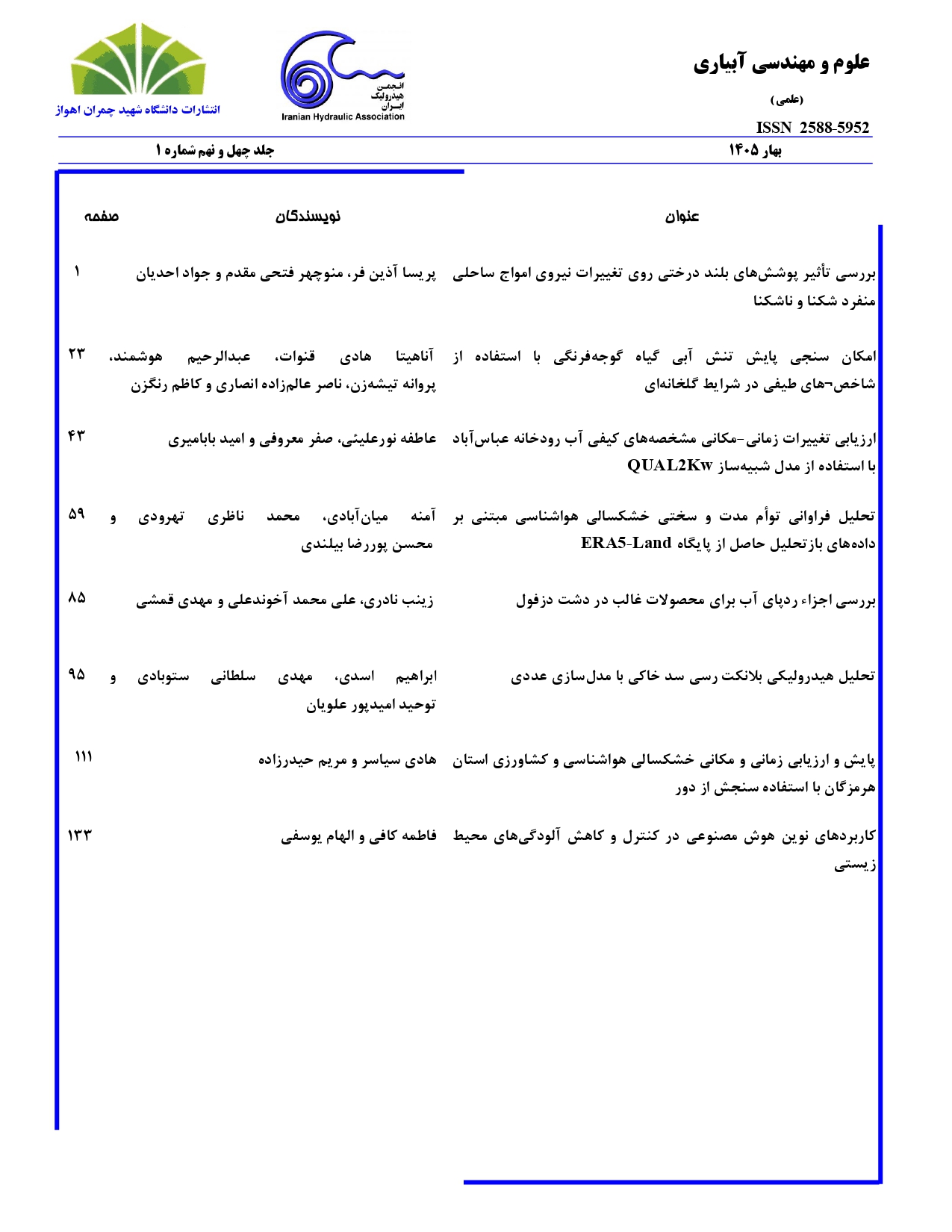
تحلیل هیدرولیکی بلانکت رسی سد خاکی با مدل‌سازی عددی

نوع مقاله : مقاله پژوهشی

نویسندگان
1 استادیار، گروه مهندسی عمران، دانشگاه شهید مدنی آذربایجان، تبریز، ایران
2 دانشجوی کارشناسی ارشد، مهندسی عمران -آب و سازه‌های هیدرولیکی- دانشگاه شهید مدنی آذربایجان، تبریز، ایران.
3 دانشجوی دکترای، مهندسی عمران -آب و سازه‌های هیدرولیکی-دانشگاه مراغه، مراغه، ایران.
چکیده
سدهای خاکی به ­دلیل نقش کلیدی در مدیریت منابع آب، کنترل سیلاب و تأمین آب کشاورزی، از اهمیت ویژه‌ای برخوردارند، اما کنترل تراوش و کاهش فشار آب حفره‌ای از چالش‌های اصلی برای تضمین ایمنی و عملکرد بلندمدت آنهاست. این مطالعه با بهره‌گیری از مدل‌سازی عددی در نرم‌افزار Seep/W از مجموعه GeoStudio، تأثیر طول و ضخامت پوشش رسی بر عملکرد هیدرولیکی سد خاکی واقع در آذربایجان شرقی را بررسی کرده است. در این پژوهش، اثرات طول‌های 6/59، 3/73، 93 و 100 متر و ضخامت‌های 5/0، 1، 5/1 و 8/1 متر بر جریان تراوش، گرادیان هیدرولیکی و فشار آب حفره‌ای تحلیل شد. نتایج نشان داد که افزایش ضخامت پوشش رسی به 5/1 متر، جریان تراوش را تا 22/55 درصد کاهش داد، در حالی که افزایش طول به 93 متر، کاهش 81/48 درصد  را به دنبال داشت. افزایش بیشتر طول و ضخامت تأثیر معناداری بر کاهش تراوش نداشت، که نشان‌دهنده بهینه بودن طول 93 متر و ضخامت 5/1 متر است. همچنین، پوشش رسی با ضخامت 5/1 متر، گرادیان هیدرولیکی خروجی را 6/60 درصد و فشار آب حفره‌ای را 94/56 درصد  کاهش داد، در حالی که افزایش طول به 93 متر به­ترتیب این پارامترها را 47/47 درصد و 58/41 درصد کاهش داد. تحلیل اقتصادی نشان داد که بهینه‌سازی ابعاد پوشش رسی، حجم خاک‌برداری را 50 درصد، ارتفاع را 30 درصد و ضخامت را 40 درصد کاهش داد و هزینه‌های عملیاتی را تا 30 درصد کم کرد، در حالی که عملکرد هیدرولیکی سد را تا 70 درصد بهبود بخشید. این یافته‌ها حاکی از آن است که انتخاب ابعاد بهینه پوشش رسی (طول 93 متر و ضخامت 5/1 متر) نه تنها تراوش را به­طور قابل‌توجهی کاهش داده و عملکرد هیدرولیکی را بهبود می‌بخشد، بلکه با کاهش چشمگیر هزینه‌های عملیاتی، رویکردی نوآورانه و اقتصادی برای طراحی سدهای خاکی ارائه می‌دهد.
کلیدواژه‌ها
موضوعات

عنوان مقاله English

Hydraulic Analysis of Clay Blanket in Earth-Fill Dams Using Numerical Modeling

نویسندگان English

Ebrahim Asadi 1
Mahdi Soltani Sotobadi 2
Tohid Omidpour Alavian 3
1 Assistant Professor of Azerbaijan Shahid Madani University - Department of Civil Engineering, Tabriz, Iran,
2 Master's Student, Civil Engineering - Water and Hydraulic Structures of Azerbaijan Shahid Madani University, Tabriz, Iran 3- Ph.D. Student, Civil Engineering - Water and Hydraulic Structures, Maragheh University, Maragheh, Iran.
3 Ph.D. Student, Civil Engineering - Water and Hydraulic Structures, Maragheh University, Maragheh, Iran.
چکیده English

Earth-fill dams play a critical role in water resource management, flood control, and agricultural water supply. However, seepage control and pore water pressure reduction remain key challenges for ensuring their long-term safety and performance. This study employs numerical modeling using Seep/W software (GeoStudio) to investigate the influence of clay cover length and thickness on the hydraulic performance of an earth-fill dam located in East Azerbaijan, Iran. The effects of lengths (59.6, 73.3, 93, and 100 m) and thicknesses (0.5, 1.0, 1.5, and 1.8 m) on seepage flow rate, hydraulic gradient, and pore water pressure were systematically analyzed. Results indicate that increasing the clay cover thickness to 1.5 m reduced seepage flow by 55.22%, while increasing the length to 93 m resulted in a 48.81% reduction. Further increases in length and thickness did not yield significant additional reductions in seepage, demonstrating that a length of 93 m and a thickness of 1.5 m are optimal. Moreover, a clay cover thickness of 1.5 m reduced the exit hydraulic gradient by 60.60% and pore water pressure by 56.94%, whereas increasing the length to 93 m reduced these parameters by 47.47% and 41.58%, respectively. Economic analysis revealed that optimizing the clay cover dimensions reduced excavation volume by 50%, height by 30%, and thickness by 40%, and operational costs by up to 30%, while improving hydraulic performance by 70%. These findings confirm that the optimal clay cover dimensions (length: 93 m; thickness: 1.5 m) not only substantially reduce seepage and enhance hydraulic performance but also provide an innovative, cost-effective approach to earth-fill dam design by significantly lowering operational costs.

کلیدواژه‌ها English

Numerical Modeling
Hydraulic Analysis
Clay Blanket
Hydraulic Gradient
Seep/W
GeoStudio


  • Chen, Y., Zhang, X., & Wang, L. 2022. Modeling saturated and unsaturated conditions in earth dams. Geotechnical Testing Journal, 45(3), 231-246. https://doi.org/10.1520/GTJ20210076


  • Johnson, R., Smith, J., & Brown, C. 1988. Initial studies on the impact of blanket dimensions on seepage control. Water Resources Research, 24(7), 1153-1160. https://doi.org/10.1029/WR024i007p01153


  • Kouhdaragh, M., Bakhshandeh, A., & Mahdavi, S. 2025. Numerical modeling of earth dam seepage reduction with clay blankets. International Journal of Hydrology, 15(2), 150-162. https://doi.org/10.1007/s41215-024-00234-5


دوره 49، شماره 1
بهار 1405
صفحه 95-110

  • تاریخ دریافت 27 فروردین 1404
  • تاریخ بازنگری 28 مرداد 1404
  • تاریخ پذیرش 16 شهریور 1404
  • تاریخ انتشار 15 اردیبهشت 1405