علوم و مهندسی آبیاری

علوم و مهندسی آبیاری

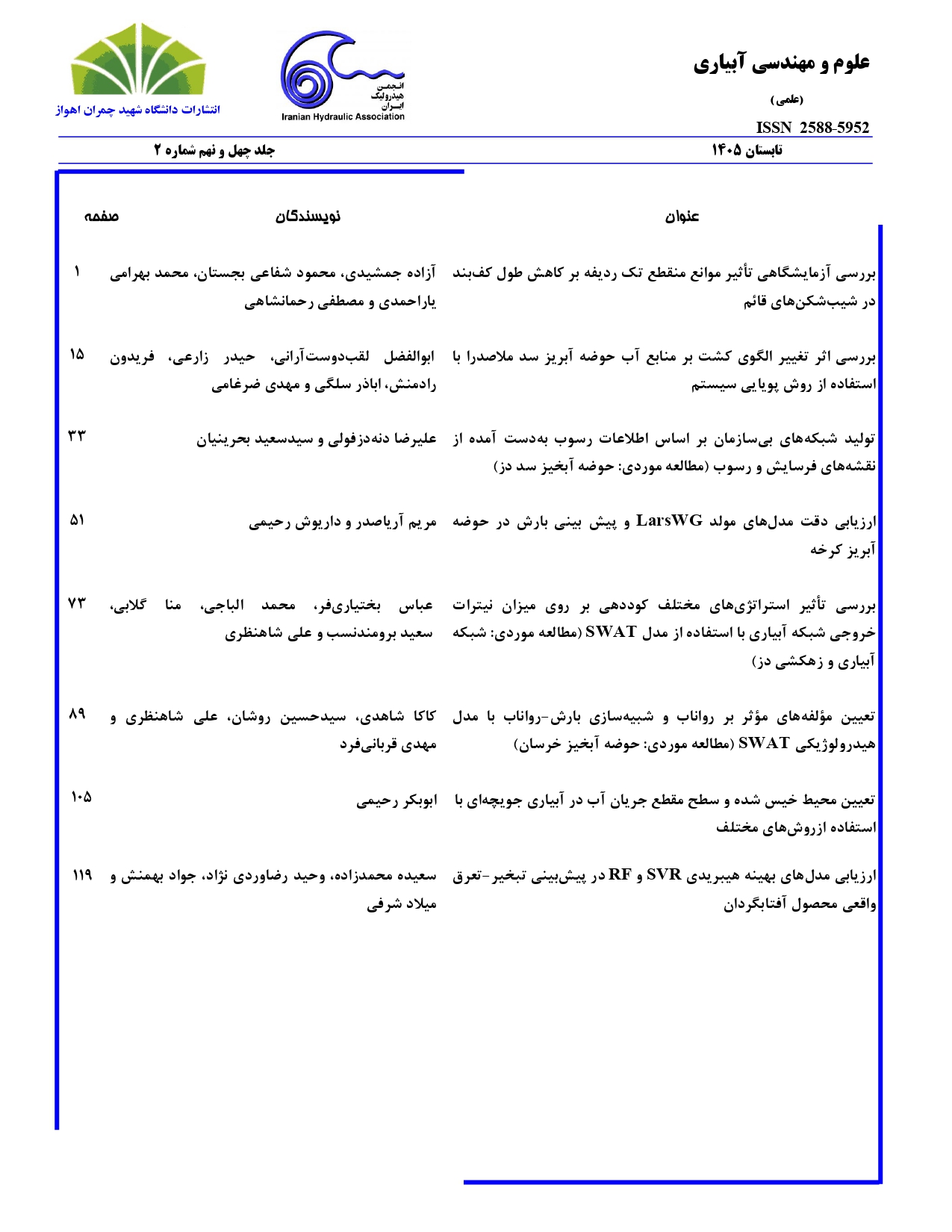
تولید شبکه های بی‌سازمان بر اساس اطلاعات رسوب به دست آمده از نقشه های فرسایش و رسوب (مطالعه موردی: حوضه آبخیز سد دز)

نوع مقاله : مقاله پژوهشی

نویسندگان
1 دانشیار گروه مهندسی مکانیک، دانشکده مهندسی، دانشگاه شهید چمران اهواز، اهواز، ایران
2 استاد گروه مهندسی مکانیک، دانشکده مهندسی، دانشگاه شهید چمران اهواز، اهواز، ایران.
چکیده
در این مقاله به تولید شبکه‌های بی‌سازمان مثلثی بر اساس اطلاعات رسوب به ­دست آمده از نقشه فرسایش و رسوب حوضه آبخیز سد دز با مساحتی بالغ بر 17320 کیلومتر مربع پرداخته شده است. الگوریتم تولید شبکه ارائه شده با یک شبکه اولیه درشت شروع به فرآیند ریزسازی شبکه می‌کند. فرآیند ریزسازی شبکه یک فرآیند تکرار است و به­طور هم­زمان از روش‌های جاگذاری گره و تقسیم سلول استفاده می‌برد. به­منظور افزایش سرعت فراخوانی اطلاعات شبکه از پایگاه‌های داده‌ای با ماتریس‌های مبنا-ضلع و مبنا-سلول استفاده شده است. یک مزیت به­کارگیری این پایگاه‌های داده‌ای در اندک بودن تعداد عملیات محاسباتی برای استخراج اطلاعات هر المان شبکه (گره، ضلع و سلول) است. به ­عنوان مثال، این پایگاه داده تنها با دو عملیات محاسباتی می‌تواند سلول‌های همسایه یک ضلع را مشخص نماید. بهبود کیفیت شبکه نهایی از دیگر گزینه‌هایی است که در الگوریتم تولید شبکه ارائه شده مورد توجه قرار گرفته است. نوآوری مقاله ارائه شده در استفاده اطلاعات فرسایش و رسوب به­منظور تطبیق و توزیع گره‌های شبکه بوده است. در این تحقیق از اطلاعات توزیع فرسایش به­دست آمده مدل پسیاک در تعریف چشمه­های ضلعی استفاده شده است. از نظر کیفی، الگوریتم ارائه­شده در کمتر از یک ثانیه به تولید شبکه­های بی­سازمان خروجی می­پردازد. بیش از 70 درصد کل سلول‌های شبکه، شبیه‌ترین به مثلث متساوی‌الاضلاع بوده‌اند.
کلیدواژه‌ها
موضوعات

عنوان مقاله English

Generation of Unstructured Grids based on Sedimentation Data Obtained from the Map of Erosion and Sedimentation (Case Study: Dez Dam Watershed)

نویسندگان English

Alireza Daneh-Dezfuli 1
Seyed Saied Bahrainian 2
1 Associate Professor, Department of Mechanical Engineering, Faculty of Engineering, Shahid Chamran University of Ahvaz, Ahvaz, Iran
2 Professor, Department of Mechanical Engineering, Faculty of Engineering, Shahid Chamran University of Ahvaz, Ahvaz, Iran.
چکیده English

This paper presents the generation of unstructured triangular grids based on the sediment data obtained from the erosion and sedimentation map of the Dez Dam watershed, covering an area of 17,320 km². The proposed grid generation algorithm starts the refinement process with a coarse initial grid. The grid refinement is an iterative process that simultaneously employs both point insertion and cell subdivision methods. Edge-based and cell-based connectivity matrices have been employed to accelerate the retrieval of grid information. An advantage of using these matrices is the minimal number of computations required to extract information for each grid element (vertex, edge, and cell). For instance, the database can identify the cells adjacent to an edge using only two computational operations. The improvement of the final grid quality is another aspect addressed in the proposed grid generation algorithm. The novelty of this paper lies in the use of erosion and sedimentation data for the adaptive distribution of grid vertices. In this study, erosion distribution data obtained from the PSIAC model were utilized to define edge sources. From a performance standpoint, the proposed algorithm produces unstructured grids in less than one second. More than 70% of the grid cells exhibit shapes close to equilateral triangles.

کلیدواژه‌ها English

Unstructured Grid
Sedemintation data
Dez dam watershed
  • Bahrainian, S.S., Daneh-Dezfuli, A., Noghrehabadi, A. 2015. Unstructured grid generation in porous domains for flow simulations with discrete-fracture network model, Transport in Porous Media 109: pp. 693-709.


  • Baker, T.J. 1989. Automatic mesh generation for complex three-dimensional regions using a constrained delaunay triangulation. Engineering with Computers, 5(3-4). pp. 161-175. Doi: 10.1007/BF02274210


  • Bowyer, A. 1981. Computing Dirichlet tessellations. Computer Journal, 24(2). pp.162-166. Doi: 10.1093/comjnl/24.2.162


  • Chew, L.P. 1989. Constrained Delaunay triangulation. Algorithmica, 4(1). pp. 97-108. Doi: 10.1145/41958.41981


  • Daneh-Dezfuli, A. and Bahrainian, S.S. 2014. A grid generation algorithm for reservoir domains with discrete fracture networks. International Journal of Oil, Gas & Coal Technology, 8(4). pp. 417-431. Doi: 10.1504/IJOGCT.2014.066303


  • Delaunay, B. 1934. Sur la Sphère Vide, A la Mémoire de Georges Voronoi. Bulletin de l'Académie des Sciences de l'URSS. Classe des sciences mathématiques et na, issue 6, pp. 793–800 (In French).


  • Dirichlet, G.L. 1850. Über die Reduktion der positiven quadratischen Formen mid drei unbestimmten ganzen Zahlen. Journal für die reine und angewandte Mathematik, 40. 209-227 (In French). Doi: 10.1515/crll.1850.40.209


  • Imai, K. 2000. Structures of triangulations of points. IEICE Transactions on Information and Systems, E83-D(3). 428-437.


  • Löhner, R. 1988. Some useful data structures for the generation of unstructured grids. International Journal for Numerical Methods in Biomedical Engineering, 4(1). 123-135. Doi: 10.1002/cnm.1630040116


  • Pirzadeh, S. 1992. Recent progree in unstructured grid generation. 30th AIAA Aerospace Sciences Meeting, AIAA Paper 92-0445, Reno, NV. Doi: 10.2514/6.1992-445


  • Pourali, S.H., Matkan, A.A. and Hosseini-Asl, A. 2008. Preparing the map of erosion hazard and sedimentation in Dez watershed by remote sensing and GIS. Environmental Sciences, 8(1). 83-100.


  • Rebay, S. 1993. Efficient Unstructured Mesh Generation by Mean of Delaunay Triangulation and Bowyer-Watson Algorithm, Journal of Computational Physics 106(1). pp. 125-138.


  • Sloan, S.W. and Houlsby, G.T. 1984. An implemenstation of Watson's algorithm for computing 2-dimensional Delaunay triangulations. Advances in Engineering Software, 6(4). 192-197.


  • Spragle, G.S., McGrory, W.R., and Fang, J. 1991. Comparison of 2D unstructured grid generation techniques. 20th AIAA Aerospace Sciences Meeting, AIAA Paper 91-0726, Reno, NV. Doi: 10.2514/6.1991-726


  • Voronoi, G.F. 1908. Nouvelles applications des paramètres continus à la théorie des formes quadratiques. Journal für die reine und angewandte Mathematik, 134. 198-287 (In French). Doi: 10.1515/crll.1908.134.198


  • Watson, D.F. 1981. Computing the n-dimensional tessellation with application to voronoi polytopes. Computer Journal, 24(2). 167-172. Doi: 10.1093/comjnl/24.2.167


  • Weatherill, N.P. 1988. A method for generating irrigular computational grids in multiply connected planar domains. International Journal for Numerical Methods in Fluids, 8(2). 181-197. Doi: 10.1002/fld.1650080206
دوره 49، شماره 2
تابستان 1405
صفحه 33-50

  • تاریخ دریافت 16 خرداد 1403
  • تاریخ بازنگری 30 مرداد 1404
  • تاریخ پذیرش 16 شهریور 1404
  • تاریخ انتشار 14 مرداد 1405