علوم و مهندسی آبیاری

علوم و مهندسی آبیاری

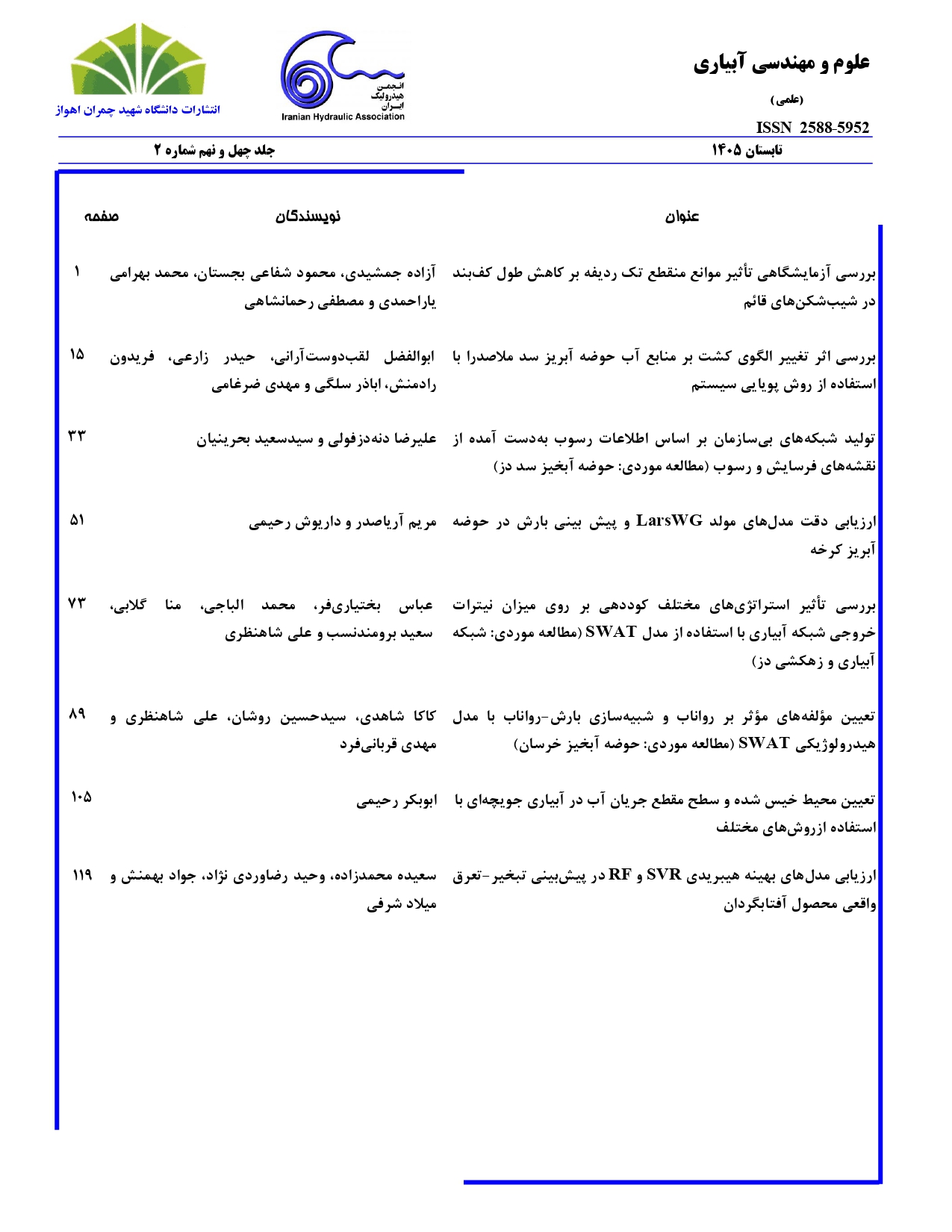
تعیین محیط خیس شده و سطح مقطع جریان آب در آبیاری جویچه ای با استفاده ازروش های مختلف

نوع مقاله : مقاله پژوهشی

نویسنده
گروه علوم ومهندسی آب، واحد سنندج،دانشگاه آزاد اسلامی، سنندج،ایران
چکیده
اغلب محصولات استراتژیک مثل  نیشکر، چغندرقند و … به روش جویچه­ای آبیاری می‌شوند. از  مهمترین عوامل مؤثر بر نفوذ آب  در جویچه­ها می­توان به محیط خیس شده، سطح مقطع جریان و ... اشاره نمود. ارزیابی محیط خیس شده و سطح مقطع جریان در آبیاری جویچه­ای نیاز به اندازه­گیری پارامترهایی مانند شکل سطح مقطع جریان، محیط خیس شده و... می­باشد. در اراضی دانشکده کشاورزی دانشگاه آزاد اسلامی سنندج برای  تعیین شیب زمین، شبکه­های 20×20 متر مربع اجرا و نقشه توپوگرافی زمین تهیه گردید. جویچه­ها به­وسیله جوی پشته­بند با مقطعی تقریباً سهمی شکل به فاصله 75/0 متر از یکدیگر و به طول 80 متر در یک بلوک مجموعاً پنج جویچه اندازه­گیری و  ده جویچه  حایل برای انجام چهار آبیاری متوالی ایجاد و آزمایش­های لازم انجام گردید. داده­ها  با استفاده از نرم­افزارهای MSTAT-C، SPSS و ... مورد تجزیه و تحلیل قرار گرفت. نتایج تجزیه واریانس داده­های  مورد آزمایش بین مقادیر متوسط محیط خیس شده در جویچه­های یک تا پنج و روش­های مقطع سنج ومعادله سهمی تفاوت معنی‌دار در سطح یک  درصد را نشان داد و ضریب تغییرات داده­ها برابر03/0 درصد می­باشد. مقادیر متوسط محیط خیس شده در دو روش مقطع سنج ومعادله سهمی به­ترتیب برابر 36/48 و 31/48  سانتی­متر  بوده است.  نتایج تجزیه واریانس داده­های مورد آزمایش بین مقادیر متوسط سطح مقطع جریان در جویچه­های یک تا پنج وروش­های مقطع سنج و معادله سهمی تفاوت معنی‌دار در سطح یک درصد داشتند وضریب تغییرات داده­ها برابر18/2 درصد می­باشد. مقادیر متوسط سطح مقطع جریان در دو روش مقطع سنج و معادله سهمی به­ترتیب برابر 28/306و43/347  سانتی­متر مربع بوده است. معادله خط برازش یافته و ضریب همبستگی، حاصل از مقادیر متوسط محیط خیس شده با روش­های مقطع سنج و معادله سهمی حاصل از دو روش اندازه­گیری برای تمامی جویچه­ها تقریباً برابر یک و برای سطح مقطع جریان حدود 99/0 می­باشد.
کلیدواژه‌ها
موضوعات

عنوان مقاله English

Determining The Wetted Perimeter and Water Flow Cross-Section in Furrow Irrigation Using Different Methods

نویسنده English

Abubakr Rahimi
Department of Water Science and Engineering,Sa.C., Islamic Azad University, Sanandaj, Iran.(
چکیده English

Most strategic crops such as sugarcane, sugar beet, and others are irrigated using the furrow method. The most important factors affecting water infiltration in the furrows include the wetted perimeter, flow cross-section, and so on. Evaluating the wetted perimeter and flow cross-section in furrow irrigation requires measuring parameters such as the cross-section, wetted perimeter, and others.At the farmlands of the Faculty of Agriculture, Islamic Azad University of Sanandaj, 20×20 meter grid was implemented to determine the land slope, and a topographical map was prepared. The furrows were created using a ridger with an approximately parabolic cross-section, spaced 0.75 meters apart and 80 meters long. A total of five measurement furrows and ten buffer furrows were created in one block for four consecutive irrigations, and the necessary experiments were conducted.The data were analyzed using MSTAT-C, SPSS, software.The Analysis of Variance results showed a significant difference at the one percent (1%) level between the mean wetted perimeter values in measurement furrows one to five and the cross-section meter and parabola equation. The coefficient of variation for this data was 0.03 percent. The mean wetted perimeter values for the cross-section meter and parabola equation methods were 48.36 cm and 48.31 cm, respectively.The results showed a significant difference at the one percent (1%) level between the mean flow cross-section values in furrows one to five and the two measurement methods. The coefficient of variation for this data was 2.18 percent. The mean flow cross-section values for the cross-section meter and parabola equation methods were 306.28 cm² and 347.43 cm², respectively.The fitted line equation and the correlation coefficient derived from the mean wetted perimeter values using the cross-section meter and parabola equation methods showed that the correlation coefficient for the wetted perimeter obtained equal to one  and for the flow cross-section, it was approximately 0.99.

کلیدواژه‌ها English

Evaluation
Manning’s
SCS
and Parabolic Equations
  • Behzad,M., Study of the effect of wetted perimeter on water penetration in furrows. PhD thesis, Faculty of Agriculture, Tarbiat Modares University, 218 pages.

2- De Queiroz, M.G., Da Silva, T.G.F., Zolnier, S., Jardim, A.M.D.R.F., de Souza, C.A.A., Júnior, G.D.N.A., de Morais, J.E.F. and de Souza, L.S.B., 2020. Spatial and temporal dynamics of soil moisture for surfaces with a change in land use in the semi-arid region of Brazil. Catena, 188, p.104457. https://doi.org/10.1016/j.catena.2020.104457


3- Dibal, J.M., Ramalan, A.A., Mudiare, O.J. and Igbadun, H.E., 2014. Scenario Studies on Effects of Soil Infiltration Rates, Land Slope, and Furrow Irrigation Characteristics on Furrow Irrigation‐Induced Erosion. International Scholarly Research Notices, 2014(1), p.942732.doi: 10.1155/2014/942732.

4- Gillies, M.H. and Smith, R.J., 2005. Infiltration parameters from surface irrigation advance and run-off data. Irrigation Science, 24(1), pp.25-35.

5- Li, J., Zhu, Y., Jin, H., Zhou, B., Han, L., Wang, H. and Wei, C., 2023. Approximate water vertical infiltration extremum path in unsaturated soils. Journal of Hydrology, 625, p.129989. https://doi.org/10.1016/j.jhydrol.2023.129989.

6- Martin, C.J.S.L., 2002. A Physically Based Two-Dimensional Infiltration Model for Furrow Irrigation. In 2002 ASAE Annual Meeting (p. 1). American Society of Agricultural and Biological Engineers. doi: 10.13031/2013.11688.

7- Mazarei, R., Mohammadi, A.S., Ebrahimian, H. and Naseri, A.A., 2021. Temporal variability of infiltration and roughness coefficients and furrow irrigation performance under different inflow rates. Agricultural Water Management, 245, p.106465. https://doi.org/10.1016/j.agwat.2020.106465

 8- Nasseri, A., Neyshabori, M.R., Fard, A.F., Mogaddam, M. and Nazemi, A.H., 2004. Field-measured furrow infiltration functions. Turkish Journal of Agriculture and Forestry, 28(2), pp.93-99.

9- Philip, J.R., 1984. Steady infiltration from circular cylindrical cavities. Soil Science Society of America Journal, 48(2), pp.270-278. https://doi.org/10.2136/sssaj1984.03615995004800020008x

10- Wöhling, T., Schmitz, G.H. and Mailhol, J.C., 2004. Modeling two-dimensional infiltration from irrigation furrows. Journal of irrigation and drainage engineering, 130(4), pp.296-303. DOI:10.1061/(ASCE)0733-9437(2004)130:4(296).

دوره 49، شماره 2
تابستان 1405
صفحه 105-118

  • تاریخ دریافت 01 تیر 1404
  • تاریخ بازنگری 18 آذر 1404
  • تاریخ پذیرش 08 دی 1404
  • تاریخ انتشار 14 مرداد 1405