علوم و مهندسی آبیاری

علوم و مهندسی آبیاری

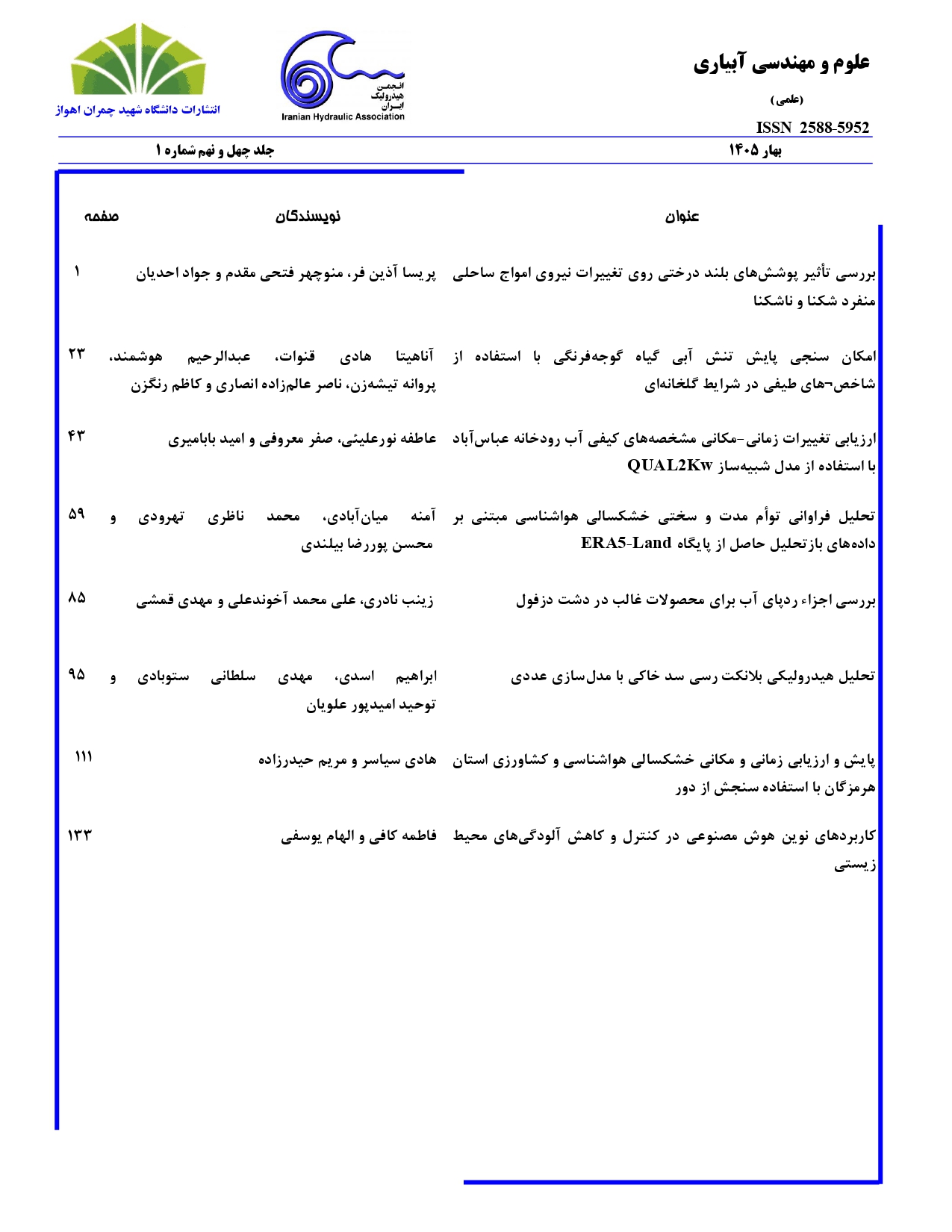
بررسی تأثیر پوشش های بلند درختی روی تغییرات نیروی امواج ساحلی منفرد شکنا و ناشکنا

نوع مقاله : مقاله پژوهشی

نویسندگان
1 دانشجوی دکتری سازه‌های آبی، دانشکده مهندسی آب و محیط زیست، دانشگاه شهید چمران اهواز.
2 استاد گروه سازه‌های آبی، دانشکده مهندسی آب و محیط زیست، دانشگاه شهید چمران اهواز
3 استاد گروه سازه های آبی، دانشکده مهندسی آب و محیط زیست، دانشگاه شهید چمران اهواز و عضو هسته قطب علمی بهسازی و بهره برداری از شبکه های آبیاری و زهکشی دانشگاه شهید چمران اهواز
چکیده
پوشش­های ساحلی به­عنوان کمربند سبز بسته به توانایی خود می­توانند نقش مهمی در کاهش خطرات موجود در ساحل و یا بازسازی ساحل از طریق کاهش امواج، تجمع و انباشت رسوبات و بازسازی خاک ایفا کنند. بنابراین نقش پوشش­های ساحلی در تغییر ویژگی­های سواحل و کاهش شدت آسیب­های وارده به آن از طریق میرایی امواج بسیار حائز اهمیت است. هدف از این تحقیق بررسی تأثیر تراکم، عرض پوشش­های بلند درختی و سرعت انتشار موج و تعیین درجة اهمیت موارد مذکور بر میزان تغییرات نیروی مخرب امواج شکنا و ناشکنا می­باشد. برای مدل کردن تنه درختان از ساقه­های چوبی بدون انعطاف به قطر یک سانتی­متر و ارتفاع 30 سانتی­متر استفاده شد. این ساقه­های استوانه­ای در قسمت ساحل فلوم نصب گردیدند و نیروی وارد شده به موانع ناشی از امواج با استفاده از روش اندازه­گیری مستقیم و به کمک نیروسنج الکترونیکی (لودسل) نصب شده در زیر قسمت متحرک فلوم، ثبت می­گردید. آزمایش­ها با آرایش ثابت موازی و فواصل متغیر 5×5 و 10×10 و در عرض­های متفاوت 10، 20 و 40 سانتی­متر و شیب ثابت صفر انجام شد. با توجه به 40 ارتفاع متفاوت موج و آزمایش­های بدون حضور پوشش (شاهد) در مجموع 280 حالت متفاوت بررسی شده است. با توجه به داده­های آزمایشگاهی، در یک عرض پوشش ثابت بیشترین افزایش جذب نیرو در تراکم 5×5 ، 81/1 برابر نسبت به تراکم 10×10 بوده است. در انتها بر اساس داده­های آزمایشگاهی یک رابطة تجربی بین ضریب درگ و عدد رینولدز پیشنهاد گردید.
کلیدواژه‌ها
موضوعات

عنوان مقاله English

the Impact of Long Tree Canopy on Changes in the Force of Solitary Breaking and Non-breaking Coastal waves

نویسندگان English

parisa Azinfar 1
Manoochehr Fathi Moghadam 2
Javad Ahadiyan 3
1 Ph.D. of Hydraulic Structures, Faculty of Water and Environmental Engineering, Shahid Chamran University of Ahvaz, Iran.
2 Professor of Hydraulic, Faculty of Water and Environmental Engineering, Shahid Chamran University of Ahvaz, Iran.
3 Professor of Hydraulic Structures, Faculty of Water and Environmental Engineering, Shahid Chamran University of Ahvaz, Iran; and Center of Excellence of the Irrigation and Drainage Networks Improvement and Maintenance, Ahvaz 61357-43311, Iran.
چکیده English

Coastal vegetation belts, depending on their capacity, can play a significant role in reducing coastal hazards or restoring the coast by attenuating waves, trapping and accumulating sediments, and rehabilitating the soil. Therefore, the role of coastal vegetation in modifying coastal characteristics and reducing the severity of damage through wave damping is of great importance. This study aims to investigate the effects of density, width of tall tree vegetation, and wave propagation velocity, as well as to determine the significance of these factors on the changes in the destructive force of breaking and non-breaking waves. To model tree trunks, non-flexible wooden stems with a diameter of 1 cm and a height of 30 cm were used. These cylindrical stems were installed on the beach section of the flume, and the force exerted on the obstacles by the waves was recorded using a direct measurement method with an electronic load cell installed beneath the movable section of the flume. The experiments were conducted with a fixed parallel arrangement, varying spacings of 5×5 and 10×10 cm, different vegetation widths of 10, 20, and 40 cm, and a constant bed slope of zero. Considering 40 different wave heights and control tests without vegetation, a total of 280 different conditions were examined. According to the experimental data, for a fixed vegetation width, the highest increase in force absorption occurred at a density of 5×5, which was 1.81 times greater than that at a density of 10×10. Finally, based on the experimental data, an empirical relationship between the drag coefficient and the Reynolds number was proposed.

کلیدواژه‌ها English

Breaking and Non-Breaking Waves
Coastal Protections
Wave Damping
Destructive Force of Waves


  • Ahadiyan, J., Abbasi Chenari, S., Azizi Nadian, H., Katopodis, C., Valipour, M., Sajjadi, S. M., & Omidvarinia, M. 2024. Sustainable systems engineering by CFD modeling of lateral intake flow with flexible gate operations to improve efficient water supply. International Journal of Sediment Research, 39(4), 629-642. https://doi.org/10.1016/j.ijsrc.2024.05.003.


  • Ahadiyan, J., Bahmanpouri, F., Adeli, A., Gaultieri, C., Khoshkonesh, A. 2022. Riprap Effect on Hydraulic Fracturing Process of Cohesive and Non-cohesive Protective Levees. Water Resource Management 36, 625–639 (2022). https://doi.org/10.1007/s11269-021-03044-6.


  • Augustin, L.N., Irish, J.L., Lynett, P. 2009. Laboratory and numerical studies of wave damping by emergent and near-emergent wetland vegetation. Journal of Coastal Engineering, 56(3), pp.332-340. https://doi.org/10.1016/j.coastaleng.2008.09.004.


  • Azinfar, P., Fathi-Moghadam, M., Ahadiyan, J. 2020. 'Laboratory Study of Broken Wave Force Damping by Submerged and Emergent Long Tree Canopies', Irrigation and Drainage Structures Engineering Research, 21(80), pp. 99-114. doi: 10.22092/idser.2020.342708.1430.


  • Davoodi, L., Fthi Moghadam, M., Ahadiyan, J., Khashefipour, S. M. 2017. 'The Effect of Coastal Forest on Variations of Broken Wave Force and Inundation Depth', Irrigation Sciences and Engineering, 40(1-1), pp. 185-199. doi: 10.22055/jise.2017.12966. https://jise.scu.ac.ir/article_12966.html.


  • Dean, R. E., 1978. Effects of vegetation on shoreline erosional processes. Pages 415–426 in Wetland Functions and Values: The state of our understanding, Proceedings of the National Symposium on Wetlands.


  • Fathi-Moghadam, M., Salmanzadeh, S., Ahadiyan, J., Sajadi, M. 2024. Drag coefficient of rigid and flexible deciduous trees in riparian forests, Journal of Hydraulic Engineering. 150 (5), 04024027. https://doi.org/10.1061/JHEND8.HYENG-13709.


  • Ghanbari Adivi, E., Fathi Moghadam, M. 2015. 'Vegetation impact on the drag coefficient and resistance of trees against shore waves', Irrigation Sciences and Engineering, 38(2), pp. 103-112. doi: 10.22055/jise.2015.11352.


  • Hashim, A. M., & Catherine, S. M. P. 2013. A Laboratory Study on Wave Reduction by Mangrove Forests. APCBEE Procedia, 5, 27-32. https://doi.org/10.1016/j.apcbee.2013.05.006.


  • Imamura, F., Goto, K., & Ohkubo, S. 2007. A numerical model for the transport of a boulder by a tsunami. Journal of Geophysical Research: Oceans, 113(C1). https://doi.org/10.1029/2007JC004170.


  • Ismail, H., Abd Wahab, A.K. and Alias, N.E., 2012. Determination of mangrove forest performance in reducing tsunami run-up using physical models. Natural hazards, 63(2), pp.939-963.https://doi.org/10.1007/s11069-012-0200-y.


  • Lashkar-Ara, B., 2010, Determination of shear stress in rectangular channel using momentum and energy approaches, Thesis, Shahid Chamran University of Ahvaz, Iran, p. 52- 62.


  • Lashkar-Ara, B., and Fathi-Moghadam, M., 2014. Analysis of shear stress in Rectangular open channels using force balance method. Journal of Hydraulic, Iranian Hydraulic Association, 9(3), pp.33-44. Doi: 30482/jhyd.2014.10174.


  • Maleki, P., Ahadiyan, J., Aleixo, R., Azizi Nadian, H., Tamoradi, Z., Kashefipour, S. M., Schleiss, A. J., & Fathi Moghadam, M. 2025. Scour Control in a 90° Bend by Means of an Air Bubble Screen. Water, 17(18), 2693. https://doi.org/10.3390/w17182693.


  • Mazda, Y., Wolanski, E., King, B., Sase, A., Ohtsuka, D., Magi, M., 1997. Drag force due to vegetation in mangrove swamps. Mangroves and Salt Marshes1, 193–199. https://doi.org/10.1023/A:1009949411068.


  • Mclvor, Al., Moller L., Spencer, T., Spalding, M., 2012. Reduction of wind and Swell Waves by Mangroves. Natural Coastal Protection Series: Report. Cambridge Coastal Research Unit Working Paper 40. Published by the Nature Conservancy and Wetlands International. file:///C:/Users/Asus/Downloads/reduction-of-wind-and-swell-waves-by-mangroves%20(1).pdf.


  • Méndez, F. J., Losada, I. J., & Losada, M. A. 1999. Hydrodynamics induced by wind waves in a vegetation field. Journal of Geophysical Research: Oceans, 104(C8), 18383-18396. https://doi.org/10.1029/1999JC900119.


  • Mohamed, A., 2008. Characterization of tsunami-like bores in support of loading on structures, Sc. Thesis, University of Hawaii, p.93.


  • Mokhtari, M., and Hajizadeh Zaker, N., 2005. Makran (Sea of Oman) is a Tsunami-Prone Area for the Iranian Coasts. 6th A/O Regional Meeting of IAPH, 1-4 Feb, Tehran, Iran.


  • Sadeghi-Hardangi, E., Ahadiyan, J. 2018. 'Hydraulically Failure Mechanism of non-Cohesive Homogenous Protective Embankments by Overtopping', Irrigation Sciences and Engineering, 41(1), pp. 115-131. doi: 10.22055/jise.2018.13575.
  • Sajjadi, S. M., Barihi, S., Ahadiyan, J., Azizi Nadian, H., Valipour, M., Bahmanpouri, F., & Khedri, P. 2024. Redesigning the Fuse Plug, Emergency Spillway, and Flood Warning System: An Application of Flood Management. Water, 16(24), 3694. https://doi.org/10.3390/w16243694.


  • Salmanzadeh, S., Fathi-Moghadam, M., Ahadiyan, J., Sajjadi, M. 2024a. An Index to Determine Reaction of Vegetation Canopies to River Flow, Journal of Hydraulic and Water Engineering, 1(2), pp. 41-50. doi: 10.22044/jhwe.2023.13441.1027.


  • Salmanzadeh, S., Fathi-Moghadam, M., Ahadiyan, J., Sajjadi, S. M. 2024b. Investigation of the Effective Parameters on the Drag Coefficient in Rigid and Flexible Vegetation, Irrigation Sciences and Engineering, 47(1), pp. 15-31. doi: 10.22055/jise.2022.41559.2035.


  • Tamoradi, Z.; Ahadiyan, J. 2021. Effect of water and air injection on the reduction of bend scour. Canadian Journal of Civil Engineering, 2021, 48, 740–748. https://doi.org/10.1139/cjce-2019-0429.


  • Thuy, B. N., Tanimoto, K., Tanaka, N., Harada, K., Limura. 2009. Effect of open gap in coastal forest on tsunami run-up-investigations by experiment and numerical simulation. Ocean Engineering. 36, pp.1258-1264. https://doi.org/10.1016/j.oceaneng.2009.07.006.
دوره 49، شماره 1
بهار 1405
صفحه 1-21

  • تاریخ دریافت 06 اردیبهشت 1399
  • تاریخ بازنگری 30 آذر 1399
  • تاریخ پذیرش 14 دی 1399
  • تاریخ انتشار 15 اردیبهشت 1405