علوم و مهندسی آبیاری

علوم و مهندسی آبیاری

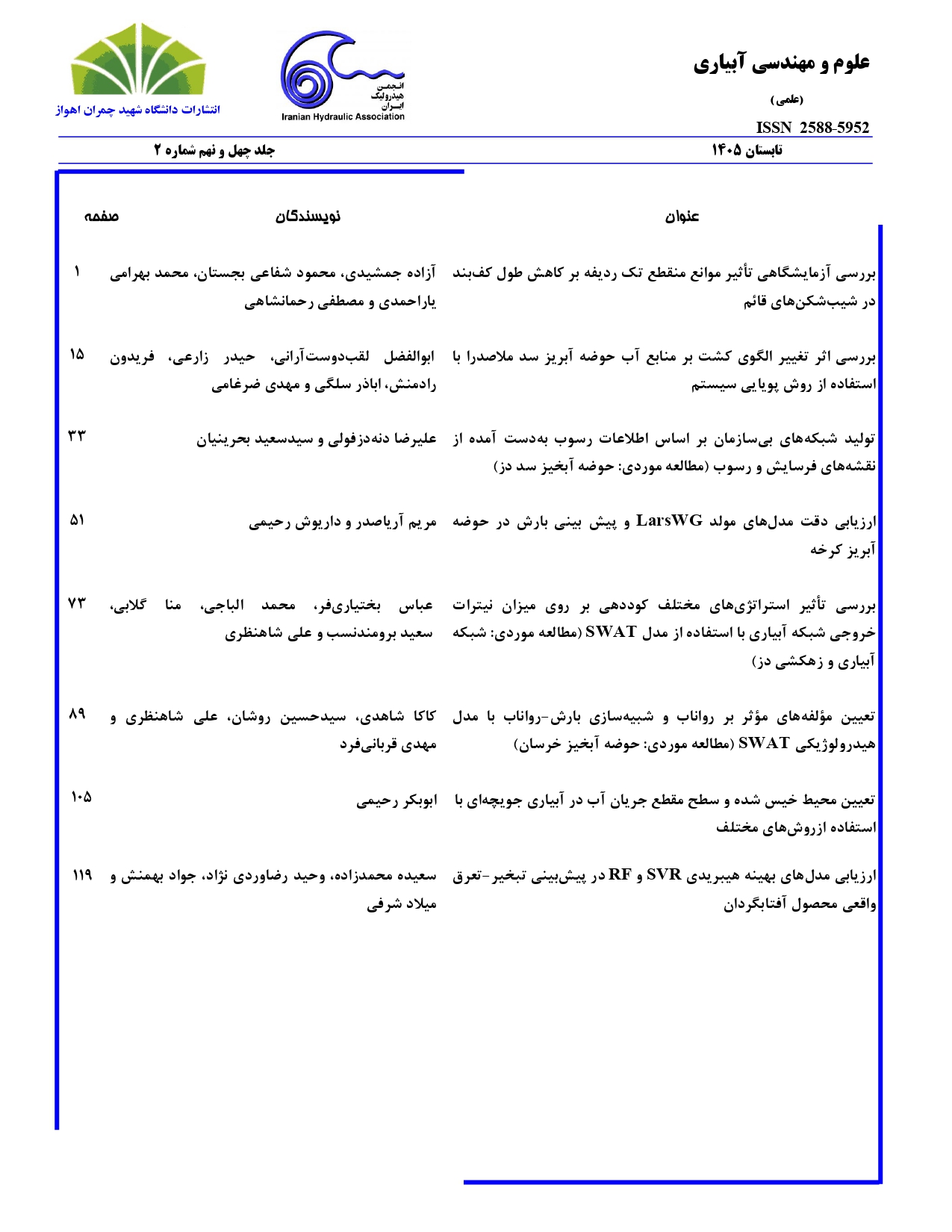
ارزیابی مدل‌های بهینه هیبریدی SVR و RF در پیش‌بینی تبخیر-تعرق واقعی محصول آفتابگردان

نوع مقاله : مقاله پژوهشی

نویسندگان
1 دانشجوی کارشناسی ارشد، گروه علوم و مهندسی آب، دانشکده کشاورزی، دانشگاه ارومیه، ارومیه، ایران.
2 استاد، گروه علوم و مهندسی آب، دانشکده کشاورزی، دانشگاه ارومیه، ارومیه، ایران.
3 استاد، گروه علوم و مهندسی آب، دانشکده کشاورزی، دانشگاه ارومیه، ارومیه، ایران
4 دانش آموحته دکتری، گروه علوم و مهندسی آب، دانشکده کشاورزی، دانشگاه ارومیه، ارومیه، ایران.
چکیده
پیش‌بینی دقیق تبخیر-تعرق واقعی در پاسخ به مشکلات مدیریت منابع آبی و افزایش بهره‌وری محصولات کشاورزی در شرایط اقلیمی خشک و نیمه‌خشک امری ضروری تلقی می‌شود. محصول آفتابگردان به‌عنوان محصول اقتصادی با دارا بودن مقاومت نسبی به کم‌آبی، گزینه‌ای مناسب برای کشت در مناطق با محدودیت آبی است. در این پژوهش، از مدل‌های رگرسیون بردار پشتیبان (SVR) و جنگل تصادفی (RF) بهینه شده با الگوریتم ژنتیک (GA) برای پیش‌بینی تبخیر-تعرق واقعی استفاده شده است. برای این ‌منظور داده‌های لایسیمترهای وزنی در منطقه بوشلند، تگزاس، ایالات متحده طی سال زراعی 2012-2011 استخراج شد. تعداد 230 داده در قالب هشت سناریو با ترکیب‌هایی از پارامترهای اقلیمی مختلف، به‌عنوان ورودی مدل انتخاب شدند. نتایج این تحقیق نشان داد در مدلSVR-GA، بهترین عملکرد مربوط به ترکیب ورودی‌هایی بود که شامل دمای روزانه خاک داخل و خارج لایسیمتر در عمق 6/1 متری، ذخیره نسبی آب در نیمه‌شب، میانگین روزانه ذخیره نسبی، دمای خاک در عمق‌های مختلف، دمای هوا، شار حرارتی خاک در ردیف‌ها و فاصله بین‌ردیف‌ها، رطوبت نسبی و سرعت باد بودند، به‌طوری‌که مقدار جذر میانگین مربعات خطا (RMSE) برابر با 017/1 میلی‌متر بر روز، ضریب همبستگی (R) معادل 95/0 و ضریب نش-ساتکلیف (NS) برابر با 908/0 حاصل شد. همچنین در مدل RF-GA، بهترین نتایج با متغیرهای ورودی شامل همه موارد فوق به‌جز سرعت باد به‌دست آمد و RMSE برابر با 516/1 میلی‌متر در روز، R معادل 90/0 و NS برابر با 796/0 بود. مقایسه نتایج نشان داد که استفاده از الگوریتم ژنتیک در بهینه‌سازی مدل‌ها باعث افزایش دقت پیش‌بینی شده است، به‌طوری‌که بر اساس معیار RMSE، مدل‌های هیبریدی SVR-GA و RF-GA  نسبت به مدل‌های مستقل خود ببه‌ترتیب کاهش 91/59 و 8/35 درصدی را تجربه کردند. در نهایت، مدل‌های هیبریدی می‌توانند به‌عنوان ابزاری کارآمد برای تخمین تبخیر-تعرق واقعی در شرایطی که اندازه‌گیری مستقیم با روش‌های سنتی پرهزینه یا محدود است، مورد استفاده قرار گیرند.
کلیدواژه‌ها
موضوعات

عنوان مقاله English

Evaluation of Optimized Hybrid SVR and RF Models for Predicting Actual Evapotranspiration of Sunflower Crop

نویسندگان English

ُSaeideh Mohammadzadeh 1
Javad Behmanesh 2
Vahid Rezaverdinejad 3
Milad Sharafi 4
1 M.Sc. Student, Department of Water Science and Engineering, Faculty of Agriculture, Urmia University, Urmia, Iran
2 Professor, Department of Water Science and Engineering, Faculty of Agriculture, Urmia University, Urmia, Iran
3 Professor, Department of Water Science and Engineering, Faculty of Agriculture, Urmia University, Urmia, Iran
4 Ph.D. Graduate, Department of Water Science and Engineering, Faculty of Agriculture, Urmia University, Urmia, Iran.
چکیده English

Accurate prediction of actual evapotranspiration in response to water resource management problems and increasing the productivity of agricultural products under dry and semi-arid climatic conditions is considered essential. Sunflower, as an economic crop with relative resistance to water deficiency, is a suitable option for cultivation in areas with water limitations. In this study, Support Vector Regression (SVR) and Random Forest (RF) models optimized with the Genetic Algorithm (GA) were used to predict actual evapotranspiration. For this purpose, data from weighing lysimeters in Bushland, Texas, USA, during the 2011–2012 growing season were extracted. A total of 230 data points were selected as model inputs in the form of eight scenarios with different combinations of climatic parameters. The results of this study showed that, in the SVR-GA model, the best performance was obtained for the combination of inputs including daily soil temperature inside and outside the lysimeter at a depth of 1.6 m, relative water storage at midnight, daily average relative water storage, soil temperature at different depths, air temperature, soil heat flux in the rows and the distance between rows, relative humidity, and wind speed, such that the Root Mean Square Error (RMSE) was 1.017 mm/day, the correlation coefficient (R) was 0.95, and the Nash Sutcliffe Efficiently (NS) was 0.908. Also, in the RF-GA model, the best results were obtained with input variables including all the above-mentioned variables except wind speed, with an RMSE of 1.516 mm/day, an R value of 0.90, and an NS value of 0.796. Comparison of the results showed that the use of the Genetic Algorithm in optimizing the models increased prediction accuracy, such that based on the RMSE criterion, the hybrid SVR-GA and RF-GA models experienced reductions of 59.91% and 35.8%, respectively, compared with their corresponding standalone models. Finally, the hybrid models can be used as efficient tools for estimating actual evapotranspiration under conditions where direct measurement using traditional methods is costly or limited.

کلیدواژه‌ها English

Water requirement
Machine learning
Random forest
Support vector regression
  • Achite, M., Samadianfard, S., Elshaboury, N. and Sharafi, M., 2023. Modeling and optimization of coagulant dosage in water treatment plants using hybridized random forest model with genetic algorithm optimization. Environment, Development and Sustainability, 25(10), pp.11189-11207.doi: 10.1007/s10668-022-02523-z.


  • Achite, M., Samadianfard, S., Elshaboury, N., Toubal, K.A., Abdelkader, E.M. and Sharafi, M., 2024. A combined support vector regression with a firefly algorithm for prediction of energy consumption in wastewater treatment plants. Water Science & Technology, 90(10), pp.2747-2763. doi: 10.2166/wst.2024.375.


3- Bayat, V.M., Zare, A.H., Maroufi, S., Sabziparvar, A.A. and Soltani, F., 2009. Simulation of reference evapotranspiration using artificial neural method and empirical methods and comparison with experimental lysimeter data in cold semi-arid climate of hamedan.
 

  • Breiman, L. 2001. Random forests. Machine learning. 45: 5-32. doi: 10.1023/A:1010933404324.


  • Chiew, FHS., Kamaladasa, NN., Malano, H.M. and McMahon, T.A. 1995. Penman-Monteith, FAO-24 reference crop evapotranspiration and class-A pan data in Australia. Agricultural Water Management. 28:9–21. doi: 10.1016/0378-3774(95)01172-F.


  • Choudhury, B. 1999. Evaluation of an empirical equation for annual evaporation using field observations and results from a biophysical model. Journal of Hydrology. 216(1-2): 99-110. doi: 10.1016/S0022-1694(98)00293-5


  • Cimen, M. 2008. Estimation of daily suspended sediments using support vector machines. Hydrological Sciences Journal. 53(3): 656-666.‏ doi: 10.1623/hysj.53.3.656


  • Da Silva Junior, J.C., Medeiros, V., Garrozi, C., Montenegro, A. and Gonçalves, G. E. (2019). Random forest techniques for spatial interpolation of evapotranspiration data from Brazilian’s Northeast. Computers and electronics in agriculture. 166(1): 1-10. Doi: 1016/j.compag.2019.105017


  • Dong, Y. and Hansen, H. 2023. Development and design of an affordable field scale weighing lysimeter using a microcontroller system. Smart Agricultural Technology. 4(1): 1-8. doi: 1016/j.atech.2022.100147.


  • Evett, S,R,, Copeland, K.S., Ruthardt, B.B., Marek, G.W., Colaizzi, P.D., Brauer, D.K. and Howell, T.A. 2022. The Bushland Maize for Grain Datasets: A Machine-readable Resource. 2022 ASABE Annual International Meeting. American Society of Agricultural and Biological Engineers. 1(1): 28-41. doi: 13031/aim.202201078.


  • Evett, S. R., Howell, T. A., Todd, R. W., Schneider, A. D. and Tolk, J. A. 2000. Alfalfa reference ET measurement and prediction. In Proceedings of the 4th Decennial National Irrigation Symposium. 17(1): 14-16.‏


  • Evett, S.R., Marek, G.W., Copeland, K.S. and Colaizzi, P.D. 2018. Quality management for research weather data: USDA‐ARS, Bushland, TX. Agrosystems, Geosciences & Environment. 1(1): 1-18.‏ doi: 10.2134/age2018.09.0036


  • Feng, K. and Tian, J. 2021. Forecasting reference evapotranspiration using data mining and limited climatic data. European Journal of Remote Sensing. 54(2): 363-371.‏ doi: 1080/22797254.2020.1801355.


  • Feng, Y., Cui, N., Gong, D., Zhang, Q. and Zhao, L. 2017. Evaluation of random forests and generalized regression neural networks for daily reference evapotranspiration modelling. Agricultural Water Management. 193(1): 163-173. doi: 1016/j.agwat.2017.08.003.


  • Gunn, S.R. 1998. Support vector machines for classification and regression, ISIS Technical Report. 14 (1): 5–16.


  • Hashemian AH, Manochehri S, Afshari D, Manochehri Z, Salari N and Shahsavari S, 2019. Prognosis of multiple sclerosis disease using data mining approaches random forest and support vector machine based on genetic algorithm. Tehran University Medical Journal 77(1): 33-40. doi: magiran.com/p1974089


  • Holland, JH. 1992. Adaptation in natural and artificial systems: an introductory analysis with applications to biology, control, and artificial intelligence. MIT Press. doi: 7551/mitpress/1090.001.0001.


  • Jha, S.K. and Hayashi, K. 2014. A novel odor filtering and sensing system combined with regression analysis for chemical vapor quantification. Sensors and Actuators B: Chemical. 200(1): 269-287.‏ doi: 1016/j.snb.2014.04.022


  • Jing, W., Yang, Y., Yue, X. and Zhao, X. 2015. Mapping Urban Areas with Integration of DMSP/OLS Nighttime Light and MODIS Data Using Machine Learning Techniques. Remote Sensing. 7(9): 12419-12439. doi: 3390/rs70912419.


  • Khosravi, K., Daggupati, P., Alami, M. T., Awadh, S. M., Ghareb, M. I., Panahi, M. and Yaseen, Z.M. 2019. Meteorological data mining and hybrid data-intelligence models for reference evaporation simulation: A case study in Iraq. Computers and Electronics in Agriculture. 167(1): 105-121. doi: 1016/j.compag.2019.105041.


  • Kumar, P. Singh, A.K. 2022. A comparison between MLR, MARS, SVR, and RF techniques: Hydrological time-series modeling. Journal of Human, Earth, and Future. 3(1): 90-98. doi: 10.28991/HEF-2022-03-01-07.


  • Lamm, F.R., Aiken, R.M. and Aboukheira, A.A. 2011. Irrigation research with sunflowers in Kansas. In: Proc. 23rd Annual Central Plains Irrig. Conf., 23rd, Burlington, 17: 169–180.


  • Marek, G.W., Evett, S.R., Gowda, P.H., Howell, T.A., Copeland, K.S. and Baumhardt, R.L., 2014. Post-processing techniques for reducing errors in weighing lysimeter evapotranspiration (ET) datasets. Transactions of the ASABE, 57(2), pp.499-515.doi: 10.13031/trans.57.10433.


  • Mokari, E., DuBois, D., Samani, Z., Mohebzadeh, H. and Djaman, K. 2022. Estimation of daily reference evapotranspiration with limited climatic data using machine learning approaches across different climate zones in New Mexico. Theoretical and Applied Climatology. 147(1): 575-587. doi: 10.1007/s00704-021-03855-y.


  • Monavar Sabegh, S. , Zarehaghi, D. , Samadianfard, S. , Neishabouri, M. R. and Mikaeili, F. 2023. Estimation of Daily Reference Evapotranspiration Using Random Forest Optimized by Genetic Algorithm. Water and Soil Science, 33(4), 33-53 (In Persian). doi: 10.22034/ws.2021.48756.2449.


  • Saravi, B., Hassel, F., Ülkümen, S., Zink, A., Shavlokhova, V., Couillard-Despres, S. and Lang, G.M. 2022. Artificial intelligence-driven prediction modeling and decision making in spine surgery using hybrid machine learning models. Journal of Personalized Medicine. 12(4): 509-524.‏ doi: 10.3390/jpm12040509.


  • Sharafi, M. , Besharat, S. and Zeinalzadeh, K. 2024. A comparative study using a data-driven method versus a hybrid approach to estimate daily reference evapotranspiration in Ahvaz. Irrigation Sciences and Engineering, 47(2), 53-68 (In Persian). doi: 10.22055/jise.2023.43524.2065.


  • Sharafi, M. and Samadianfard, S. 2024. Prediction of daily evaporation values using support vector regression coupled with firefly algorithm in the coastal areas of Iran. Water and Soil Science, 34(1), 39-53 (In Persian). doi: 10.22034/ws.2023.54178.2500.


  • Shiri, N. , Kazemi, M. H. and Shiri, J. 2021. Application of empirical and random forest models in estimating reference evapotranspiration of humid regions. Water and Soil Science, 31(2), 1-11 (In Persian). doi: 10.22034/ws.2021.12356.


  • Smola, A. J. and Schölkopf, B. 2004. A tutorial on support vector regression. Statistics and computing. 14(1): 199-222.‏ doi: 10.1023/B:STCO.0000035301.49549.88.


  • Talukdar, S., Mallick, J., Sarkar, S. K., Roy, S. K., Islam, A. R. M. T., Praveen, B. and Sobnam, M. 2022. Novel hybrid models to enhance the efficiency of groundwater potentiality model. Applied Water Science. 12(4): 62-75.‏ doi: 10.1007/s13201-022-01571-0.


  • Tolk, J.A. and Howell, T.A. 2012. Sunflower water productivity in four Great Plains soils. Field Crops Research. 127(2): 120-128.‏ doi: 10.1016/j.fcr.2011.11.012.


  • Tyralis, H., Papacharalampous, G. and Langousis, A. 2019. A brief review of random forests for water scientists and practitioners and their recent history in water resources. 910(1):15-36. doi: 10.3390/w11050910.


  • Wang, S., Lian, J., Peng, Y. and Chen. H. 2019. Generalized reference evapotranspiration models with limited climatic data based on random forest and gene expression programming in Guangxi, China. Agricultural Water Management. 221(1): 220-230. doi: 10.1016/j.agwat.2019.03.027.


  • Wu, L., Huang, G., Fan, J., Ma, X., Zhou, H. and Zeng, W. 2019. Hybrid extreme learning machine with meta-heuristic algorithms for monthly pan evaporation prediction. Computers and Electronics in Agriculture. 168(1): 105-115. doi: 10.1016/j.compag.2019.105115.


  • Xiong, Y.J., Chen, X., Tang, L. and Wang, H. 2022. Comparison of surface renewal and Bowen ratio derived evapotranspiration measurements in an arid vineyard. Journal of Hydrology. 613(1): 22-37. doi: 1016/j.jhydrol.2022.128474.


  • Yoon, H., Jun, S.C., Hyun, Y., Bae, G.O. and Lee, K.K. 2011. A comparative study of artificial neural networks and support vector machines for predicting groundwater levels in a coastal aquifer. Journal of hydrology. 396(1-2): 128-138.‏ doi: 1016/j.jhydrol.2010.11.002


  • Zouzou, Y. and Citakoglu, H. 2023. General and regional cross-station assessment of machine learning models for estimating reference evapotranspiration. Acta Geophysica. 71(2): 927-947.‏ doi: 10.1007/s11600-022-00939-9.
دوره 49، شماره 2
تابستان 1405
صفحه 119-142

  • تاریخ دریافت 11 خرداد 1404
  • تاریخ بازنگری 01 شهریور 1404
  • تاریخ پذیرش 24 شهریور 1404
  • تاریخ انتشار 14 مرداد 1405