علوم و مهندسی آبیاری

علوم و مهندسی آبیاری

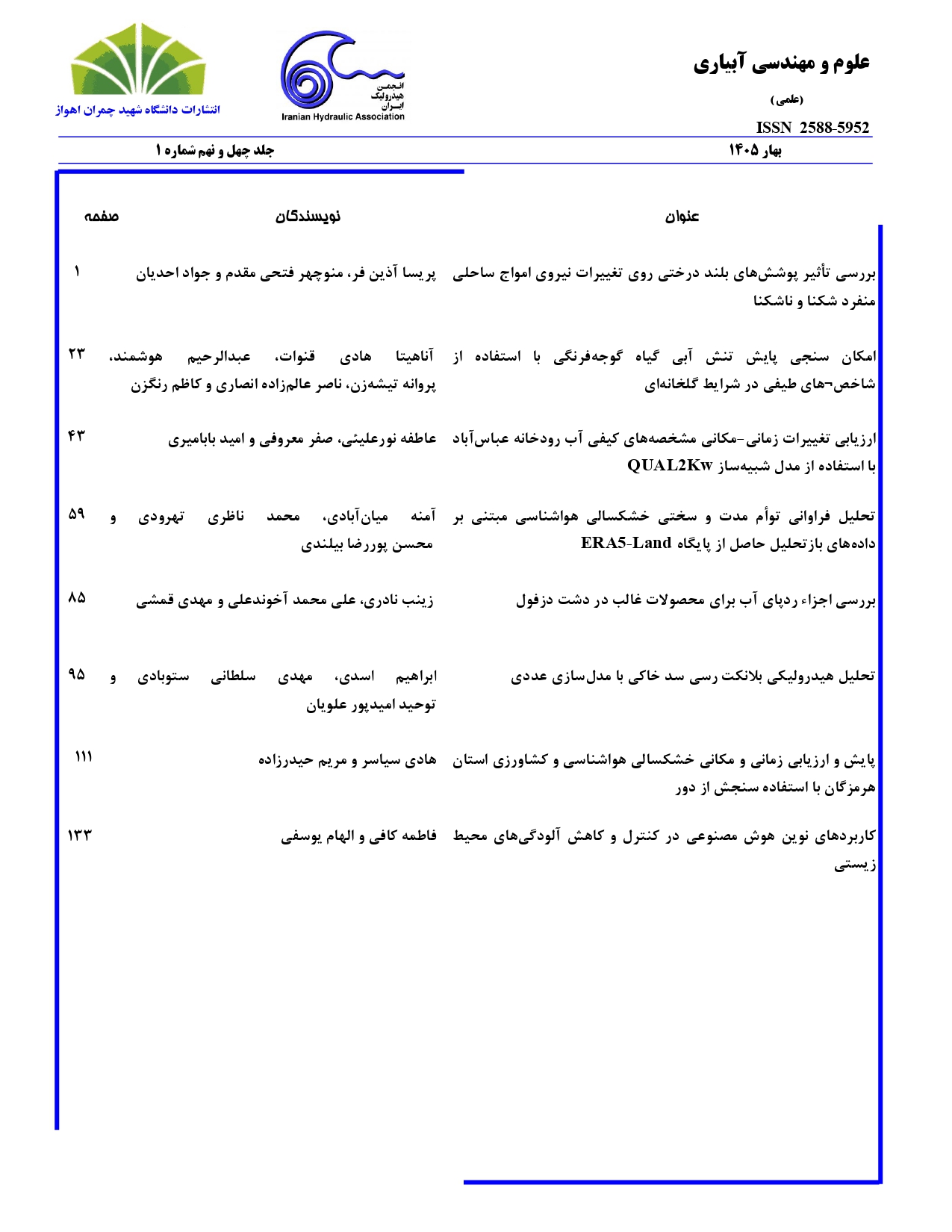
بررسی اجزاء ردپای آب برای محصولات غالب در دشت دزفول

نوع مقاله : مقاله پژوهشی

نویسندگان
1 دانش آموخته دکتری مهندسی منابع آب، دانشکده مهندسی آب و محیط زیست، دانشگاه شهید چمران اهواز.
2 استاد گروه هیدرولوژی و منابع آب، دانشکده مهندسی آب و محیط زیست، دانشگاه شهید چمران اهواز، ایران.
3 استاد گروه سازه‌های آبی، دانشکده مهندسی آب و محیط زیست، دانشگاه شهید چمران اهواز.
چکیده
منابع آب هر کشور در چهار بخش صنعت ،کشاورزی، شرب و محیط زیست مصرف می­شود. باتوجه به این­که عمده مصرف منابع آب در کشور در بخش کشاورزی صورت می­گیرد لذا ارزیابی مقدار آب واقعی مورد استفاده محصولات کشاورزی از اهمیت بالایی برخوردار است. برآورد میزان آب واقعی محصولات کشاورزی از طرق شاخص­های متفاوتی صورت می­گیرد و لازم است شاخص­های مؤثرتری در تخصیص بهینه منابع آب در نظر گرفته شوند که ازجمله مؤثرترین آن­ها می­تواند شاخص ردپای آب باشد. در این تحقیق برای ارزیابی وضعیت محصولات کشاورزی از نظر آب مصرفی از دیدگاه شاخص ردپای آب (WF) برای عمده محصولات غالب کشت شده در دشت دزفول استفاده گردید. در این مطالعه مشخص گردید از 97/31 میلیون مترمکعب آب که در طول سال برای کشت محصولات انتخابی مصرف می­شود 2/46 درصد مربوط به جزء آبی، 2/50 درصد مربوط به جزء سبز و 67/3 درصد مربوط به جزء خاکستری است. در خصوص جزء خاکستری که معادل 17/1 میلیون متر مکعب در سال می­باشد می­توان گفت که اگرچه این مقدار آب به چرخه آبی منطقه برمی­گردد لیکن کاهش کیفیت آب مسأله بسیار مهمی است که باید در برنامه­ریزی­های کلان مورد توجه قرار گیرد. با وجود تولید 17/1 میلیون مترمکعب آب خاکستری، بررسی پایداری محیط زیستی منطقه از لحاظ سطح آلودگی نشان داد که منطقه مورد بررسی با توجه به شاخص WPL (پایداری ردپای آب خاکستری با استفاده از سطح آلودگی آب) در سطح پایداری قرار دارد.
کلیدواژه‌ها
موضوعات

عنوان مقاله English

Investigation of water footprint components for dominant crops in Dezful plain

نویسندگان English

Zeinab Naderi 1
Alimohamad Akhondali 2
Mehdi Ghomeshi 3
1 1- Ph. D Of Water Resources Management ,Faculty Of Water Science and Engineering ,Shahid Chamran University Of Ahvaz,Ahvaz,Iran.
2 Professor, Faculty of Water and Environmental Engineering, Shahid Chamran University of Ahvaz, Ahvaz, Iran.
3 Professor Hydraulic Structures Department, Faculty of Water and Environmental Engineering, Shahid Chamran University of Ahvaz, Ahvaz, Iran.
چکیده English

This research assesses the water resource consumption of agricultural products in the Dezful Plain, emphasizing the critical role of the Water Footprint (WF) index for optimal resource allocation in Iran, where agriculture dominates water usage. Based on the findings from Table (1), the study evaluated the WF of major crops, revealing an annual consumption of 31.97 million cubic meters. This total comprises 46.2% blue water, 50.2% green water, and 3.67% grey water. While the 1.17 million cubic meters of annual grey water discharge re-enters the hydrological cycle, the associated water quality degradation poses a significant challenge for planning. Nonetheless, an assessment of environmental sustainability using the Water Pollution Level (WPL) index indicates that the region remains sustainable despite the production of grey water. This highlights the necessity of considering water quality impacts alongside quantity in comprehensive water resource management.

کلیدواژه‌ها English

Pollution level
Sustainability Assessment
Green Waterfootprint
  • Ababaei, B. and Etedali, H.R., 2017. Water footprint assessment of main cereals in Iran. Agricultural Water Management, 179, pp.401-411.https://doi.org/10.1016/j.agwat.2016.07.016.


  • Aldaya, M.M., Martínez-Santos, P. and Llamas, M.R., 2010. Incorporating the water footprint and virtual water into policy: Reflections from the Mancha Occidental Region, Spain. Water Resources Management, 24(5), pp.941-958. DOI 10.1007/s11269-009-9480-8.


  • Allen, R.G., Pereira, L.S., Raes, D. and Smith, M., 1998. FAO Irrigation and drainage paper No. 56. Rome: Food and Agriculture Organization of the United Nations, 56(97), p.e156.


  • Alizadeh, A. 2003. Principles of Applied Hydrology. 17th edn. Mashhad: Imam Reza University Press. (In Persian).


  • Gorgin, P.F., Ramezani, E.H. and Ababaei, B. 2016 ‘Estimation of grey water footprint in the production of important crops at provincial and national scales’, in Proceedings of the Second National Congress of Irrigation and Drainage of Iran, Isfahan. (In Persian).


  • Hoekstra, A.Y. and Chapagain, A.K., 2007. Water footprints of nations: water use by people as a function of their consumption pattern. Water Resources Management, 21(1), pp.35-48.


  • Hoekstra, A.Y., 2011. The water footprint assessment manual: Setting the global standard. Routledge.


  • Hoekstra, A.Y. and Chapagain, A.K., 2011. Globalization of water: Sharing the planet's freshwater resources. John Wiley & Sons.


  • Lu, Y., Zhang, X., Chen, S., Shao, L. and Sun, H., 2016. Changes in water use efficiency and water footprint in grain production over the past 35 years: a case study in the North China Plain. Journal of Cleaner Production, 116, pp.71-79. https://doi.org/10.1016/j.jclepro.2016.01.008⁠.


  • Mekonnen, M.M. and Hoekstra, A.Y., 2011. The green, blue and grey water footprint of crops and derived crop products. Hydrology and Earth System Sciences, 15(5), pp.1577-1600.


  • Seydan, H. 2001 ‘Export water or water supply to dry areas’, Journal of Khorasan, 2, pp. 41–51.


  • Sumner, D.M. and Jacobs, J.M. 2005 ‘Utility of Penman–Monteith, Priestley–Taylor, reference evapotranspiration, and pan evaporation methods to estimate pasture evapotranspiration’, Journal of Hydrology, 308(1–4), pp. 81–104. https://doi.org/10.1016/j.jhydrol.2004.10.023⁠.


  • Cao, X., Wu, P., Wang, Y. and Zhao, X. 2014 ‘Water footprint of grain product in irrigated farmland of China’, Water Resources Management, 28, pp. 2213–2227. https://doi.org/10.1007/s11269-014-0619-3.


  • Zhuo, L., Mekonnen, M.M., Hoekstra, A.Y. and Wada, Y. 2016 ‘Inter- and intra-annual variation of water footprint of crops and blue water scarcity in the Yellow River basin (1961–2009)’, Advances in Water Resources, 87, pp. 29–41. https://doi.org/10.1016/j.advwatres.2015.11.002⁠.
دوره 49، شماره 1
بهار 1405
صفحه 85-94

  • تاریخ دریافت 30 بهمن 1398
  • تاریخ بازنگری 25 آذر 1399
  • تاریخ پذیرش 14 دی 1399
  • تاریخ انتشار 15 اردیبهشت 1405